Kawah Ijen's Blue Fire Is Not Blue Lava
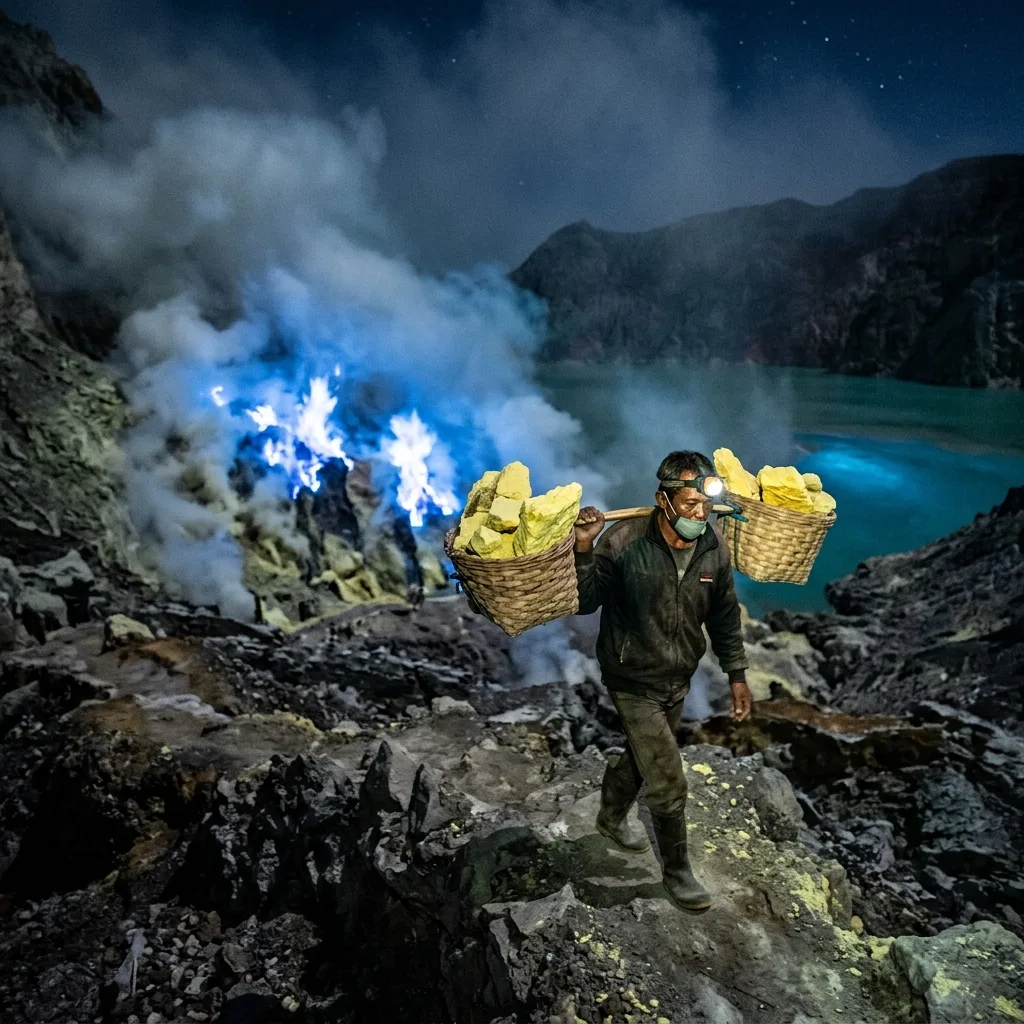
What actually burns inside Indonesia's Ijen crater—and the sulfur miners who work beside it.
You've probably seen photographs of Kawah Ijen's blue lava. The electric-blue rivers flowing through the darkness of this East Javanese volcanic crater have made it one of the most shared geological anomalies on the internet. There is only one problem: it isn't lava.
What Actually Burns at Ijen
The phenomenon at Kawah Ijen is a massive combustion event. Deep within the volcanic complex, high-pressure sulfurous gases (such as hydrogen sulfide) escape through rocky fumaroles at temperatures exceeding 600 degrees Celsius (1,112 degrees Fahrenheit). When this superheated gas makes contact with oxygen-rich air, it instantly ignites, burning with a bright blue flame and producing highly toxic sulfur dioxide gas. Some of the burning elemental sulfur condenses into a liquid state as it burns, slowly flowing down the rock face while remaining engulfed in the vivid blue flame.
Why You Can Only See It at Night
Because the combustion is a gas fire rather than molten rock, the flames are relatively faint. During daylight hours, the burning sulfur is practically invisible, appearing only as dense plumes of yellowish-white smoke. The intense blue color is most visible in dark conditions and becomes difficult to distinguish once sunlight strengthens. Therefore, observation of the blue fire is typically done before sunrise.
Is Ijen Really the Only Place on Earth With Blue Fire?
Travel media frequently claims that Kawah Ijen is the only place in the world where blue fire exists. This is geologically inaccurate. The phenomenon can occur at any highly active sulfur-venting volcano. For instance, similar blue flames have been documented at Dallol in Ethiopia and occasionally during eruptions at Kilauea in Hawaii. What makes Kawah Ijen unusual is not that blue sulfur flames are physically impossible elsewhere, but that the phenomenon has been repeatedly observed and photographed there on a large, sustained scale.
The Sulfur Mine Inside the Crater
The blue fire is only a byproduct of what makes Kawah Ijen a site of blunt economic reality. The same volcanic vents that produce the famous flames also produce immense quantities of solid sulfur. When the gas cools, it hardens into bright yellow blocks. For decades, local men have descended into this highly toxic environment—a crater containing the world's largest highly acidic crater lake with a pH near zero—to extract the chemical for use in cosmetics and sugar refining.
What a 70–90 Kilogram Load Means
The extraction relies entirely on human muscle. Miners break the yellow slabs with steel rods and load them into twin bamboo baskets. A typical load weighs between 70 and 90 kilograms. They must carry this weight up a steep, rocky path for 300 meters while breathing dense sulfur dioxide, and then hike three kilometers down the exterior flank. Occupational-health studies, including research from Universitas Airlangga, have documented musculoskeletal complaints, including severe lower-back pain, among Ijen sulfur miners.
Tourism Arrived in a Working Landscape
Today, tourists and miners share the exact same trail. At 3:00 AM, the path is crowded with international visitors wearing respirators and carrying tripods. Navigating through them are the miners, carrying loads that often exceed their own body weight. Visitors are generally expected to give way to miners carrying heavy loads along the narrow trail. The miners cough through the toxic fumes while visitors photograph the glowing blue vents just meters away.
What Photographs of Ijen Usually Leave Out
Austrian documentarian Michael Glawogger, in his 2005 film Workingman's Death, famously captured the unvarnished reality of the Ijen crater before it became a viral destination. The core truth of the mountain remains unchanged. When dawn breaks over the caldera, the blue fire vanishes into the morning light. The tourists descend toward their waiting buses, while the miners light fresh kretek cigarettes and adjust their bamboo poles for another climb.
Frequently Asked Questions
Is Kawah Ijen's blue fire actually lava?
No. The blue light comes from the combustion of sulfurous gases (such as hydrogen sulfide) and elemental sulfur escaping the volcano at high temperatures. When exposed to oxygen, these sulfur compounds ignite, burning with a bright blue flame and producing highly toxic sulfur dioxide gas. Some of the burning sulfur condenses into a flowing liquid, creating the illusion of blue lava.
Is it dangerous for tourists to hike into Kawah Ijen?
Yes, there are significant risks. The hike is strenuous, and inside the crater, sulfur gas is highly toxic and can cause respiratory distress. Wearing a proper industrial gas mask is highly recommended for safety, as is hiring an experienced local guide.
How can tourists responsibly interact with the sulfur miners?
Always give miners the right of way on the narrow paths. Their loads are extremely heavy, and stopping their momentum is physically punishing. Do not treat them merely as photo props; if you wish to support them, buy their small sulfur carvings or tip them directly if you photograph them.