The Juru Kunci: Reading the Volcano Between Ritual and Science
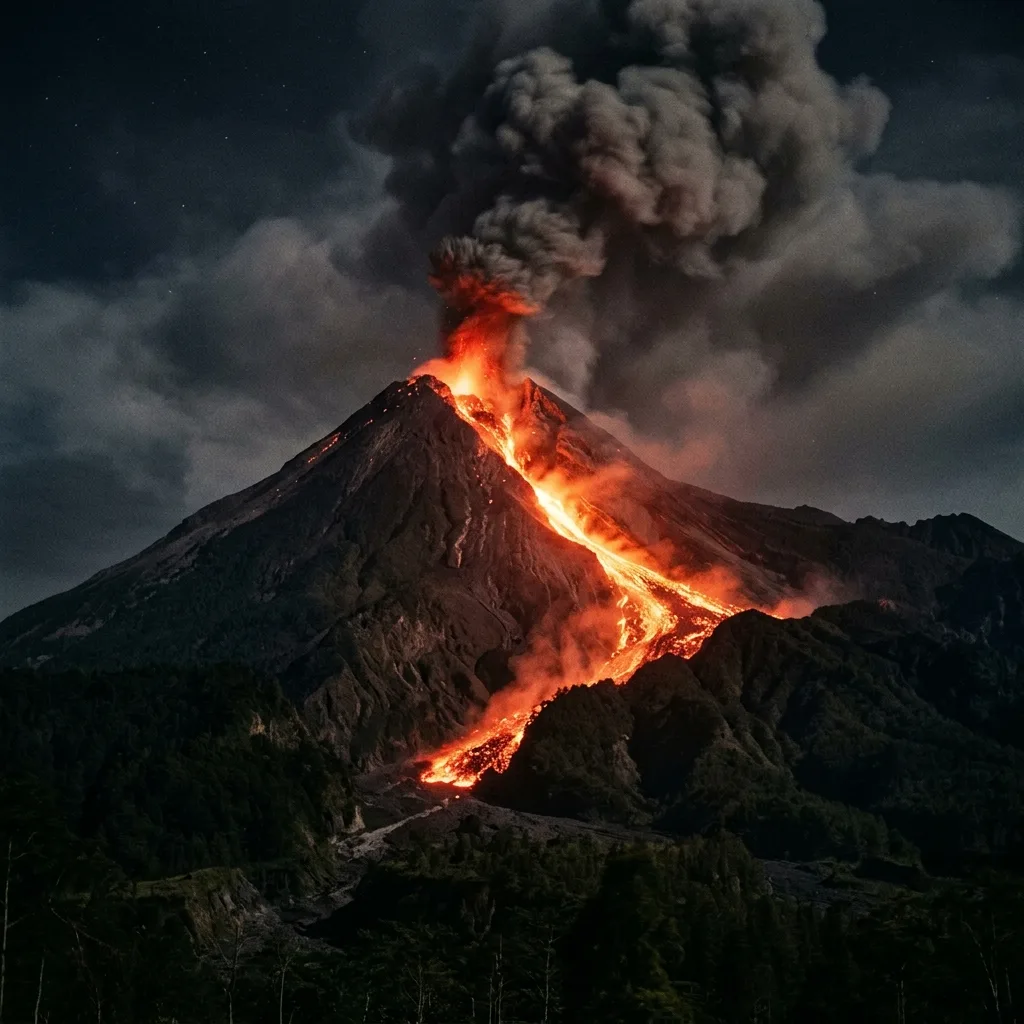
Why does an active volcano need a gatekeeper? The story of Mbah Maridjan reveals how Javanese cosmology, royal rituals, and modern volcanology coexist on Mount Merapi.
Inside the monitoring room of the BPPTKG in Yogyakarta, digital needles trace the seismic pulse of Mount Merapi on glowing screens. Just twenty miles north, on the steep flanks of the same mountain, villagers prepare woven baskets of rice, red chilies, and frangipani flowers. The government geologists measure the stratovolcano’s activity in sulfur dioxide emissions and harmonic tremors, while the local residents understand it through the nuanced moods of the crater's spiritual inhabitants. These are not competing truths, but rather two entirely different frameworks used to make sense of Merapi—a landscape defined by sudden geological violence.
The Sultan's Cosmic Geography
In traditional Javanese cosmology, Merapi is much more than a geological hazard. It forms the northern anchor of an invisible, highly sacred cosmic axis. This straight line cuts directly south through the Tugu monument, passes through the Sultan's royal palace in Yogyakarta, and ends in the treacherous currents of the Indian Ocean, the domain of the mythological Queen of the South Sea. Within the ritual relationship between the palace and the spiritual landscape of Merapi, the Sultan appoints a court retainer known as a Juru Kunci.
The Juru Kunci is a spiritual gatekeeper. As documented by anthropologist Judith Schlehe in her 1996 research on Javanese mystical traditions, the role is not designed to magically stop eruptions. Instead, the gatekeeper leads the annual Labuhan ritual, offering clothes, food, and hair trimmings from the Sultan to the mountain to maintain cosmic balance. For decades, this heavy responsibility fell to an unassuming village elder named Mbah Maridjan, who lived in Kinahrejo, just four kilometers from the smoking summit.
When Ritual Duty Met an Evacuation Order
The tension between ritual obligation and disaster mitigation became starkly real in October 2010. As government seismographs spiked and volcanologists issued evacuation orders, Mbah Maridjan refused to leave his home. His decision was frequently read by outside observers as a rejection of evacuation orders. However, his position as Juru Kunci provided a more complex context: he viewed guarding Merapi as a strict obligation tied to his duty to the Sultan. To him, abandoning his post would be a fundamental breach of that responsibility.
On October 26, the mountain entered a highly energetic explosive phase. Driven by intense internal pressure, the eruption triggered a massive pyroclastic flow—known locally as wedus gembel because its rolling form resembles matted goat hair—that tore down the southern flanks at speeds exceeding 100 kilometers per hour. The superheated cloud of volcanic gas and debris slammed into Kinahrejo and killed dozens of people. When rescue teams finally accessed the village, evacuation reports noted that Mbah Maridjan's body was found in a position resembling Islamic prayer.
Tombs and Tourism in the Ash
The landscape left behind by these recurring eruptions is stark, particularly around the Kaliadem bunker. Built into the hillside to protect residents from airborne ash, the heavy concrete structure became a tomb during an earlier eruption in 2006. Two volunteers sought refuge inside as a pyroclastic flow descended. The bunker was entirely buried under 2.5 meters of searing volcanic material, resulting in their deaths. Today, its steel door remains visible amidst the hardened volcanic material, serving as a reminder of the two victims of the 2006 eruption.
In the years following the 2010 disaster, jeep tourism began to develop in the affected areas, providing some residents with a new source of income. Villagers who had lost their cattle and farmland pooled resources to purchase aging, open-top Willys Jeeps, eventually establishing the Merapi Lava Tour. Visitors now hire these local operators to navigate the rocky tracks, stopping at the skeletal remains of houses and the Kaliadem bunker.
The Lava Tour exists in a grey area between the commercialization of disaster memory and the survival strategy of a community that lost its primary livelihood. Merapi demands constant negotiation. Down in the valley, the digital seismograph continues to print its erratic, analytical lines across a rolling sheet of paper. High up on the volcanic slopes, a fresh woven basket of red chilies slowly dries in the afternoon sun.
Frequently Asked Questions
Can you hike to the summit of Mount Merapi?
Access to the summit depends entirely on the official alert level set by the BPPTKG. Because Merapi is highly active, trekking routes from Selo are frequently closed for safety reasons. Never rely on generic travel advice for access; always check the current geological status before planning a visit.
What is the Merapi Lava Tour?
The Lava Tour is a local tourism initiative that developed following the 2010 eruption. Visitors hire open-top Willys Jeeps driven by locals to explore the devastated landscape, visiting sites like the Kaliadem bunker and museums built from destroyed homes.
Who was Mbah Maridjan?
Mbah Maridjan was the Juru Kunci (spiritual gatekeeper) of Mount Merapi, tasked by the Sultan of Yogyakarta to perform rituals for the mountain. He died during the 2010 eruption after refusing to evacuate, fulfilling what he viewed as his obligation to guard the peak.