Komodo Dragons Don't Kill With "Deadly Bacteria"
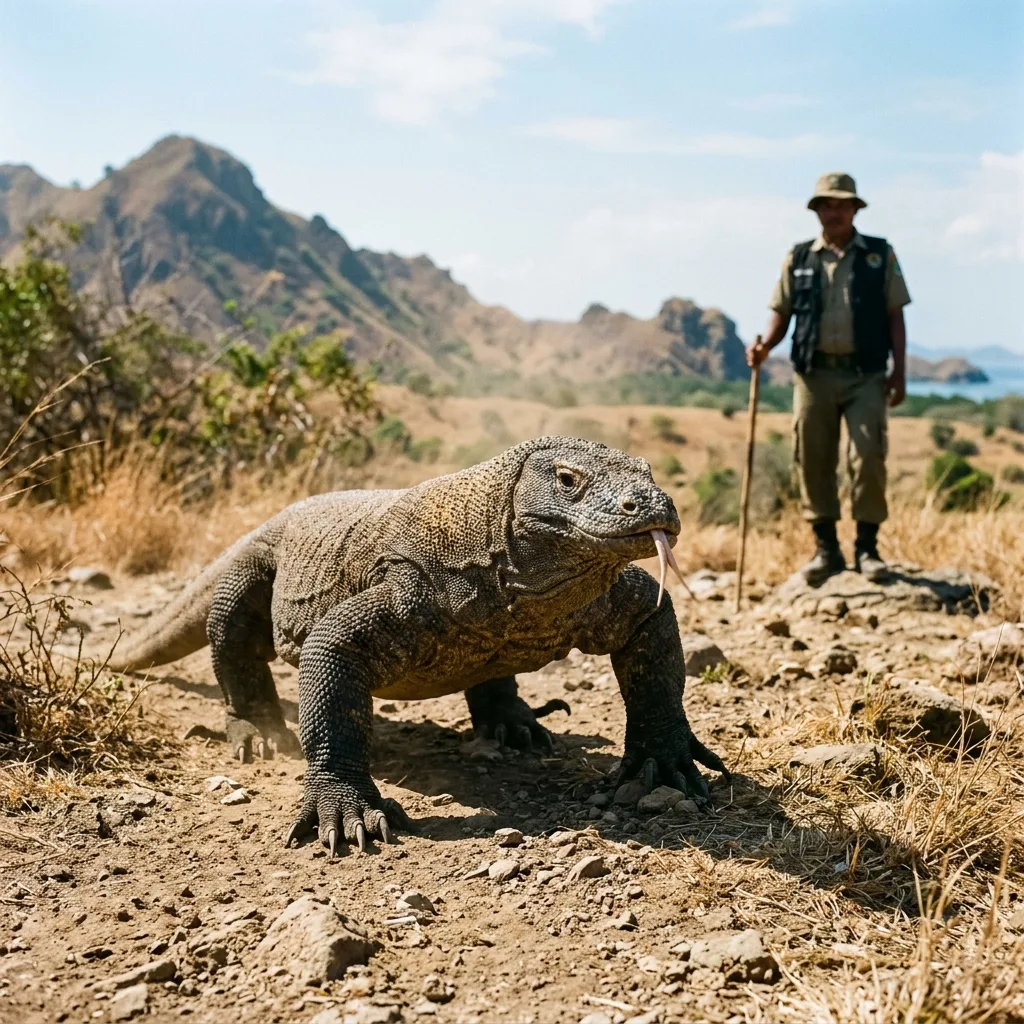
For decades, documentaries claimed the Komodo dragon killed prey with a mouth full of rotting bacteria. Modern research reveals they actually rely on complex venom and massive mechanical trauma.
In the dry brush of the Lesser Sunda Islands, a heavy reptile tracks its prey. For decades, documentaries and nature guides taught a simple, terrifying story about how this animal hunts. The popular narrative claimed that if a Komodo dragon (Varanus komodoensis) bites a water buffalo, the animal doesn't die from the wound itself, but from a cocktail of rotting bacteria left in the lizard's saliva. The dragon simply tracks the infected prey for days until it dies from septic shock.
This explanation was accepted scientific canon for years. It gained significant traction following the work of biologist Walter Auffenberg, whose 1981 book The Behavioral Ecology of the Komodo Monitor shaped early understanding of the species. The theory made intuitive sense: early swab samples of captive dragons showed diverse pathogens, and the idea of a patient, infectious scavenger fit perfectly with the grim aesthetic of the heavy lizard.
What Researchers Actually Found
The narrative shifted in 2009. A team led by venomologist Dr. Bryan G. Fry at the University of Melbourne published a study in the Proceedings of the National Academy of Sciences that challenged the pathogenic bacteria explanation. Using MRI technology on a terminally ill dragon in a zoo, researchers found complex venom glands in the lower jaw. Furthermore, when they analyzed the bacteria in wild dragons' mouths, they found it was generally no different from that of an ordinary mammalian carnivore. There was no highly specialized, cultivated death-bacteria.
If it isn't a septic bite, how does a dragon take down a large water buffalo? The reality is a mechanical and chemical synergy often described by researchers as "grip, rip, and drip." A dragon's skull is relatively light but designed to resist high pulling loads. It bites with serrated teeth and forcefully pulls back, causing massive lacerations. The venom glands then secrete proteins that prevent blood clotting and cause a rapid drop in blood pressure. The prey goes into shock from rapid, unstoppable blood loss and severe mechanical trauma, not from a slow, festering infection.
The "Living Dinosaur" Myth
The "dirty mouth" isn't the only misconception. Tourism marketing frequently bills the Komodo dragon as a "living dinosaur" that has been isolated on Komodo and Rinca islands for millions of years. In truth, fossil evidence suggests that the ancestors of Varanus komodoensis evolved in Australasia and only migrated to the Indonesian archipelago much later. And their habitat isn't strictly limited to the famous national park islands; scattered populations also exist on the larger, more populated island of Flores.
The People Who Never Saw Monsters
Long before Western naturalists began analyzing their saliva, the indigenous Ata Modo people understood the dragons through a completely different paradigm. In the oral traditions of the island, humans and dragons share a maternal bloodline. The foundational legend of Putri Naga (The Dragon Princess) tells of a woman who gave birth to twins: a human boy named Gerong, and a female dragon named Ora.
Because of this story, the Ata Modo historically refer to the dragons as sebae, meaning "twins" or "the other half." As documented by Dutch anthropologist J.A.J. Verheijen and contemporary researchers, this belief fostered a culture of cautious coexistence. Rather than adversarial hunting, the oral tradition established a framework where the dragons were treated with the caution afforded to dangerous relatives.
When "Jurassic Park" Came to Rinca
Today, that delicate coexistence is navigating aggressive modernization. In 2020, the Indonesian government began a massive infrastructure redevelopment on Rinca Island to accommodate premium tourism. The project sparked an international outcry after a photograph of a dragon facing down a construction truck went viral, prompting critics and the media to dub the development "Jurassic Park."
The government insisted the elevated viewing decks and renovated facilities were necessary upgrades that wouldn't harm the ecosystem. However, the scale of the concrete poured into the savanna prompted the UNESCO World Heritage Committee to formally request a halt to construction in 2021 to properly assess the environmental impact.
Trekking through the park today runs on a strict permit system. You walk the dry trails flanked by a local ranger carrying a simple forked wooden stick, serving as a basic physical barrier between groups of tourists and the heavy lizard. The Komodo dragon—an animal that kills through complex venom and mechanical shock, shares a mythical bloodline with the island's natives, and now finds its home covered in fresh concrete—never killed with bacteria. Between the animal the Ata Modo call sebae and the tourists who come to photograph it, there is now a construction crane on one side, and a ranger's forked wooden stick on the other.
Frequently Asked Questions
Are Komodo Dragons dangerous to humans?
Yes. They are formidable predators with venom and powerful jaws. While attacks on tourists are extremely rare because visitors must be accompanied by trained rangers, locals have been injured. You must follow the ranger's instructions at all times.
What is the best way to travel to Komodo Island?
You must first fly to Labuan Bajo in Flores (usually from Bali or Jakarta). From there, the only way to reach the islands is by boat. Most visitors book a multi-day liveaboard cruise or a fast-boat day tour to explore the park.