The Smoked Mummies of the Dani: Ancestral Guardians of the Baliem Valley
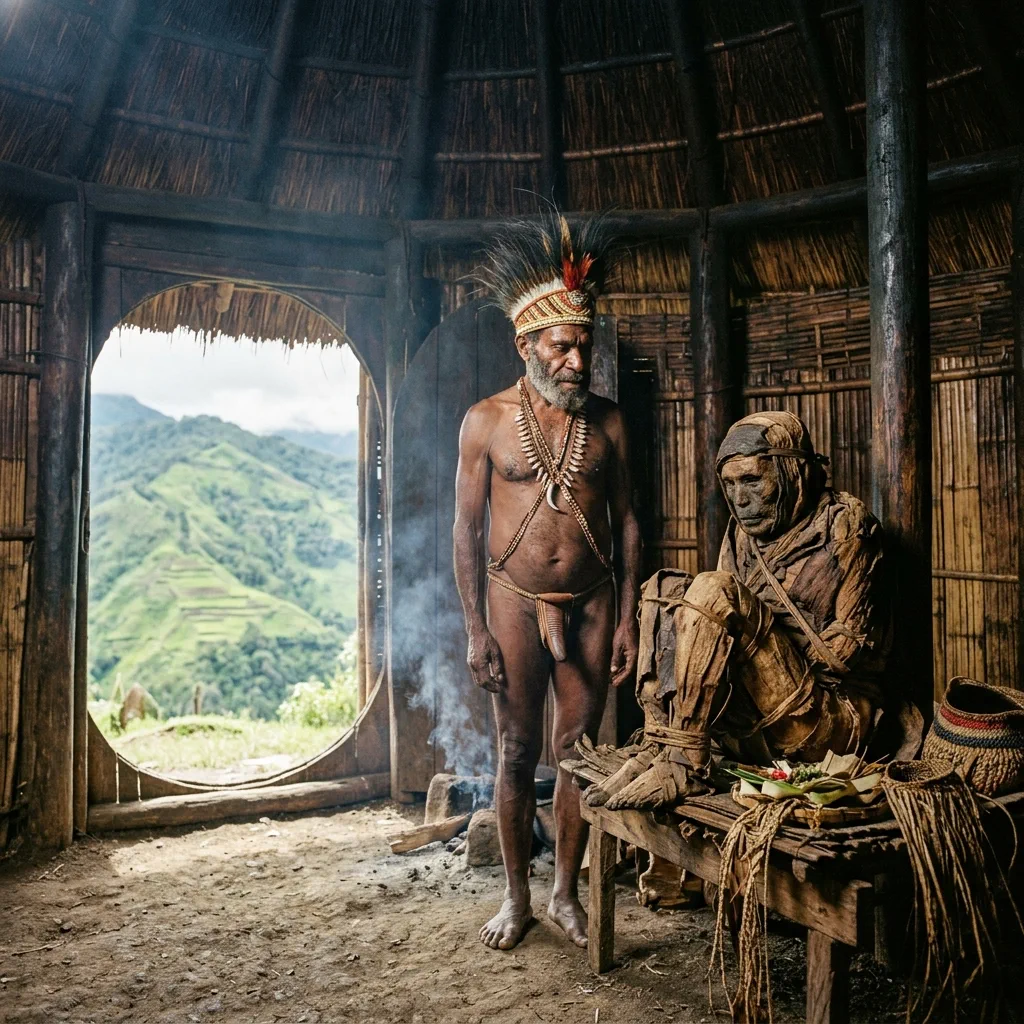
In Papua's Baliem Valley, several preserved mummies offer a rare glimpse into traditions once used by certain communities to honor high-status ancestors.
In 1938, Richard Archbold's zoological expedition brought the Baliem Valley to sustained Western attention after reconnaissance flights revealed a densely populated agricultural landscape in New Guinea's central highlands. While the vast terraced gardens of the region were remarkable, another aspect of the local culture drew significant ethnographic interest: certain communities in and around the Baliem Valley preserved high-status ancestors through smoke-drying.
Mummification was not a universal practice for the diverse groups collectively known as the Dani. It was a rare honor reserved exclusively for respected elders or influential war leaders who had made significant contributions to their people. When such a leader passed away, the community chose not to inter the body. Instead, the deceased was placed into a sitting fetal posture and subjected to a traditional preservation process a traditional preservation process.
The body was suspended over a slow-burning fire inside a honai, a traditional windowless thatched-roof hut. Over time, prolonged exposure to smoke and heat dried and preserved the body. According to ethnographers like Karl Heider, tribal elders would also periodically rub the skin with pig fat and botanical resins. This traditional method cured the tissue, creating a durable state capable of withstanding the humid highland climate.
The Role of the Guardian
The most famous surviving example of this practice is the mummy of Wimotok Mabel, described in local accounts as a prominent war leader, now kept in the village of Jiwika (Kurulu). Popular accounts often assign Wimotok Mabel an age of several centuries, although such estimates are based on oral tradition rather than scientific dating. These smoked chieftains are not kept on public display. They reside permanently in the restricted areas of a designated honai, often belonging to the current chief or a specific caretaker.
The preservation of the physical body is directly tied to the community's spiritual cosmology. It is believed that the spirit of the great ancestor remains connected to the physical remains. These ancestors function as guardians; their preserved presence is traditionally relied upon to bestow blessings such as fertile sweet potato harvests, Their presence has traditionally been associated with ancestral protection and blessings, including agricultural fertility.
The Disappearance of Traditional Mourning
The intense connection to grief and the dead historically extended to physical mourning practices among the living. The most prominent was Ikipalin, the ritual amputation of finger segments by women following the death of a close relative, manifesting emotional sorrow physically. Today, Ikipalin and mummification are no longer widely continued, amid major religious, political, and social changes in the highlands during the 20th century. However, the hands of elderly Dani women still bear the physical records of these past mourning rituals.
The Valley Today
The Baliem Valley has navigated profound cultural shifts since the mid-20th century. Paved roads now connect previously isolated villages to the town of Wamena, and the annual Baliem Valley Cultural Festival draws international visitors. While the lifestyle in the highlands continues to modernize, the remaining smoked mummies, like Wimotok Mabel in Jiwika, continue to be maintained by their communities—serving as tangible, physical links to the complex ancestral history of the valley.
Frequently Asked Questions
Are there many smoked mummies left in the Baliem Valley?
No, there are only a handful remaining today. The most famous ones are kept in the villages of Jiwika (Wimotok Mabel) and Akima. The practice of mummification was halted by the Indonesian government and Christian missionaries decades ago.
Can anyone touch the mummies?
Visitors should not touch a mummy unless explicitly permitted by its custodians. Access and photography rules are determined locally and should be respected.
Do Dani women still cut off their fingers (Ikipalin)?
Ikipalin is no longer widely practiced. Historical accounts and surviving physical evidence among some older women document the practice, but it should not be treated as representative of Dani women today.
What was the purpose of the 1938 Archbold Expedition?
The 1938 expedition, sponsored by the American Museum of Natural History, was primarily a zoological and botanical survey to collect specimens in unmapped regions of New Guinea. During reconnaissance flights, Richard Archbold and his team sighted the heavily cultivated Baliem Valley, bringing its large, previously isolated populations to sustained Western and academic attention.