Banda Islands: The 1621 Massacre Behind the VOC Nutmeg Monopoly
Giles Milton's *Nathaniel's Nutmeg* offers an accessible narrative history of the English-Dutch struggle over the Banda Islands and the early modern spice trade.
On May 8, 1621, outside the stone walls of Fort Nassau, the Dutch East India Company (VOC) executed 40 aristocratic elders and village leaders of the Banda Islands. Today, this remote cluster in Indonesia's Maluku province is a quiet diving destination, but in the early 17th century, it was the world's principal—and effectively exclusive—source of nutmeg. This biological monopoly made the islands the center of global spice trade, attracting European fleets. The VOC's objective was not simply military control of Banda, but the enforcement of an absolute monopoly over the nutmeg trade.
The conflict had been building for years. The indigenous Bandanese insisted on their right to trade freely with English, Portuguese, and Asian merchants, repeatedly rejecting the VOC's demands for exclusive contracts. Frustrated by this resistance, Jan Pieterszoon Coen, the Governor-General of the VOC, abandoned diplomatic negotiation in favor of overwhelming force. Historian Willard A. Hanna, in his 1978 seminal book Indonesian Banda: Colonialism and Its Aftermath in the Nutmeg Islands, documented how Coen arrived with a massive fleet of 13 ships, nearly 2,000 armed European soldiers, and dozens of Japanese samurai mercenaries to permanently enforce the company's monopoly.
Following the execution of the 40 Orangkaya leaders, the VOC systematically pursued the rest of the islanders. Estimates of the pre-conquest Bandanese population are commonly placed around 15,000. According to historical records analyzed by scholars like Leonard Y. Andaya, after the VOC campaign, only a fraction remained on the islands; others were killed, enslaved, deported to Batavia, or starved while hiding in the mountains.
The Architecture of Replacement
Having effectively depopulated the islands, the VOC faced an immediate labor crisis. To harvest the highly lucrative nutmeg (pala) and mace (fuli), Coen initiated a radical demographic restructuring. He imported thousands of enslaved laborers from Java, other parts of Maluku, and India. The islands were carved into agricultural estates known as perken, which were handed over to retired Dutch soldiers and loyal company men, known as the perkeniers.
This created a rigid plantation society built directly over the remnants of the original settlements. The indigenous Bandanese culture, including the intricate social structure of the Orangkaya, was nearly extinguished on the home islands. Some Bandanese managed to escape eastward across the treacherous Banda Sea to the distant Kei Islands. Today, communities in villages like Banda Eli and Banda Elat preserve forms of the original Bandanese language and oral traditions. These cultural survivals preserve perspectives that are largely absent from the surviving Dutch colonial records.
What the Forts Don't Tell You
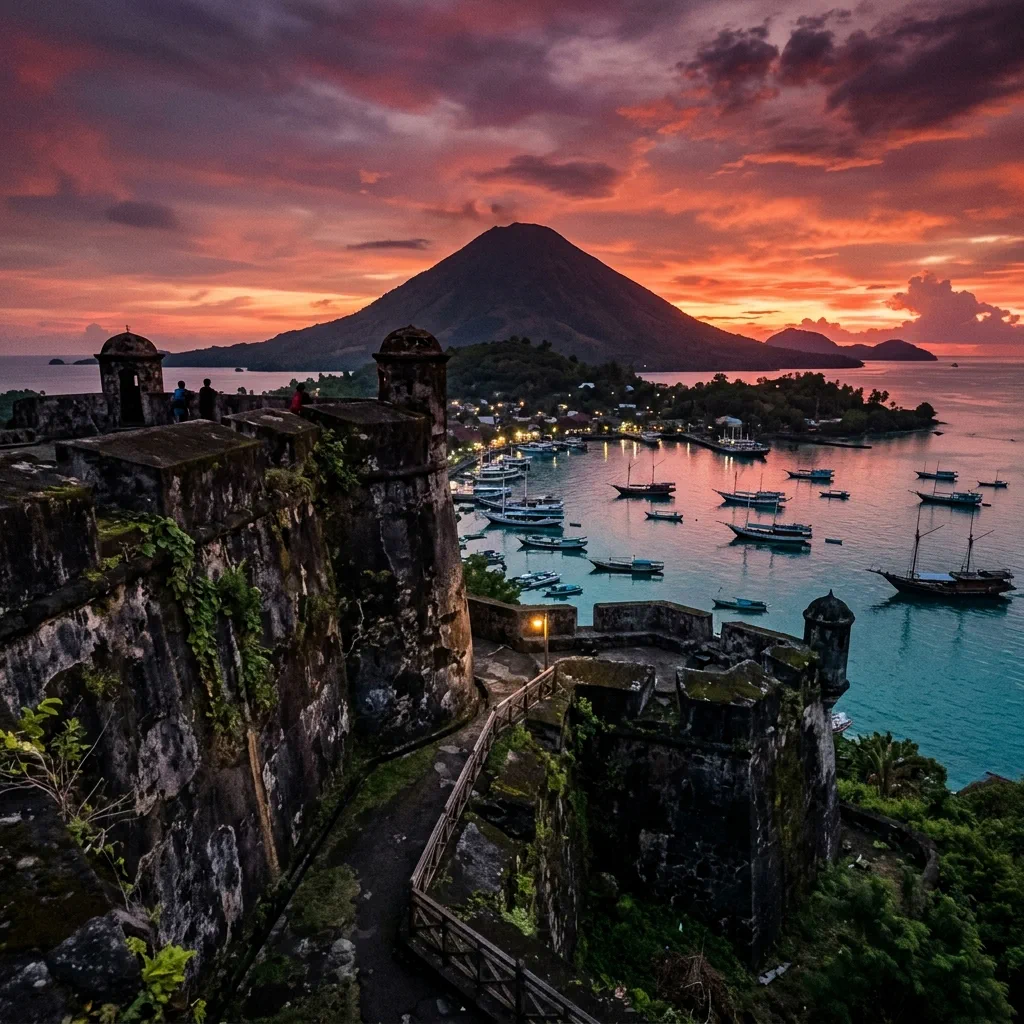
Modern tourism in Bandaneira presents a complex landscape. Visitors sleep in restored perkenier mansions and visit the European architecture of Fort Belgica and Fort Nassau. However, the violence that created this colonial heritage landscape is not always physically apparent. The original Bandanese settlements were replaced so thoroughly that the islands' current atmosphere—charming colonial decay shaded by ancient nutmeg trees—can obscure the history of extraction and displacement.
Four centuries later, nutmeg still grows in Banda. The VOC's monopoly system has long since vanished, but the forts, the remnants of the plantation estates, and the Bandanese diaspora communities remain as traces of the human cost once paid for one of the world's most sought-after spices.
Frequently Asked Questions
Was the VOC a private company or a government?
The VOC was a chartered trading company, but it exercised powers normally associated with states, including maintaining armies, building forts, making treaties, and governing conquered territories. The massacre was executed to secure corporate control, utilizing the company's quasi-sovereign military power.
Who are the current inhabitants of the Banda Islands?
The population of today's Banda Islands reflects centuries of migration, including descendants of enslaved laborers, exiles, migrants, colonial-era settlers, and Bandanese communities that survived the VOC period. Descendants of Bandanese refugees also live in the Kei Islands, particularly around Banda Eli and Banda Elat.
Is Fort Nassau open to tourists today?
Fort Nassau can be visited in Bandaneira. The fort is closely associated with the 1621 execution of Bandanese orang kaya under the VOC.
Why was the VOC so obsessed with nutmeg?
During the 17th century, nutmeg was an incredibly lucrative luxury commodity in Europe, prized for culinary uses and believed by some to have protective medical properties. Because the Banda Islands were the world's principal source of the spice, enforcing a monopoly guaranteed the VOC immense profits.