Omed-Omedan: The Misunderstood 'Kissing Ritual' of Sesetan
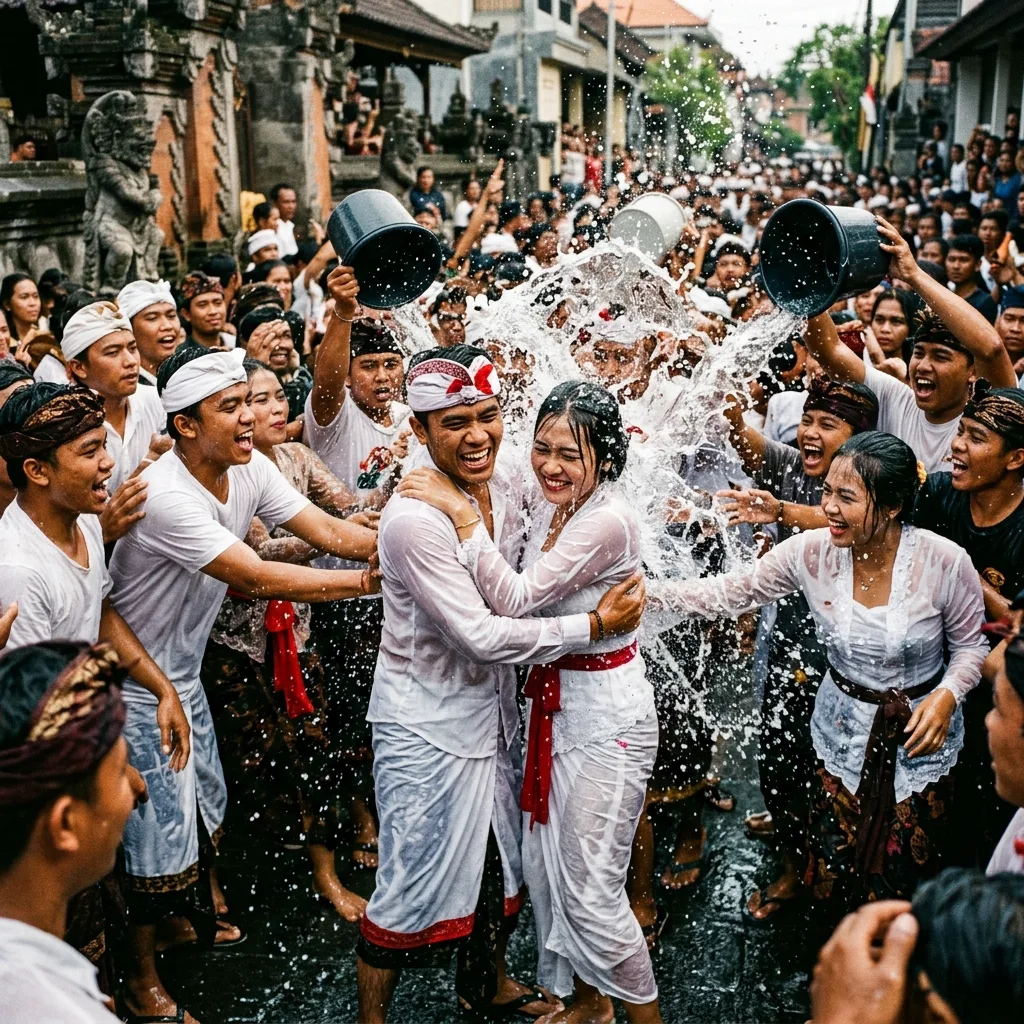
A day after Nyepi's island-wide silence, the youth of Banjar Kaja Sesetan perform a ritual of pulling, pushing, and water-splashing that media shorthand reduces to a 'kissing festival' — stripping away a healing origin story, a near-abolition in 1984, and 24 hours of quiet that give the noise its meaning.
Every visitor sees the same thing. Two lines of young people in white traditional clothing surge toward each other down a narrow street in Sesetan, South Denpasar, the morning after Nyepi. The frontmost man and woman are pushed together by their peers, arms locked, faces pressed close, before buckets of water crash over them and the crowd roars. Dozens of phones rise from the crowd. Travel blogs will later describe the moment as a "kissing festival," a quirky Balinese mating ritual.
The label is not entirely wrong — bodies do collide, faces do sometimes make contact. But calling Omed-omedan a "kissing festival" is like calling a Javanese wayang performance a "puppet show." Technically accurate; practically meaningless.
The Story Behind the Ritual
According to oral tradition preserved by the community of Banjar Kaja Sesetan, the ritual traces back to the Puri Oka kingdom — a story the village dates, loosely, to the 17th century. In the most widely told version, the penglingsir (elder leader) of Puri Oka, known as Anak Agung Made Raka or Ida Bhatara Kompiang, fell gravely ill during the Nyepi period. He issued a request: no noise, no commotion in front of the puri. Respecting this, villagers stayed away, unable even to visit.
The young men and women of Banjar Kaja, frustrated and saddened by their distance from the stricken elder, began pulling and pushing each other in the street — a spontaneous, boisterous game of med-medan (tug-and-push). The commotion reached the puri. The elder, according to the community's telling, emerged furious at the disturbance — but when he witnessed the spectacle of his villagers laughing and grabbing at each other in the street, his illness lifted. He recovered. Before his death, community elders recount, he asked that the med-medan game be repeated every year at the same time as a form of collective gratitude and communal tightening (Simakrama).
This origin story — healing through communal noise and physical play — is what Omed-omedan participants understand themselves to be enacting, not a public display of romantic interest.
The 1984 Near-Disappearance
The label "kissing festival" is not just a tourist invention. It created a genuine institutional crisis in 1984, when the tradition came close to being permanently abolished.
That year, critics — including voices from within Puri Oka itself, according to accounts gathered by Dinas Pariwisata Denpasar — argued that public physical contact between unmarried young men and women was considered inappropriate and contrary to local norms of decency. A serious proposal emerged to end the ritual.
Community elders, however, point to what happened next as proof of the ritual's sacred status: two pigs appeared and began fighting in the street where Omed-omedan is normally held, an apparition the community interpreted as a warning from unseen forces. Whatever the source of that coincidence, the debate closed quickly. The abolition was dropped, and the ritual continued. In accounts gathered from Banjar Kaja, elders describe the incident as the moment the community recognized that Omed-omedan is a tradition that should not be abandoned.
From Village Ritual to Scheduled Heritage Event
The ritual underwent one significant institutional change in the same decade. Parisada Hindu Dharma Indonesia (PHDI), the national body overseeing Hindu religious practice in Indonesia, moved in the 1980s to standardize Catur Brata Penyepian — the four prohibitions of Nyepi — as a full 24-hour observance. Since Omed-omedan had previously been performed on the afternoon of Nyepi itself, the community relocated it to the following morning, Ngembak Geni, where it has been held ever since.
More recently, the event has grown in visibility. The city government of Denpasar has lent it the framing of a "Heritage Festival," and the event now draws crowds of domestic and international visitors. Researchers at Universitas Udayana have documented this shift, noting how the increasing public staging of Omed-omedan raises questions about where a living village ritual ends and a managed cultural performance begins. At the same time, the core mechanics of the ritual remain in the hands of Banjar Kaja: the sekaa teruna-teruni (the organized youth body, limited to unmarried members aged 17 to 30) governs the participation, and pecalang enforce strict limits. Outsiders are absolutely prohibited from joining the pulling.
What Visitors Usually Miss
For a visitor standing at the edge of the crowd on Ngembak Geni morning, the spectacle compresses into a few loud minutes. What is harder to see from that position is its relationship to the 24 hours of island-wide silence that preceded it.
Nyepi means no lights, no vehicles, no noise, no going outside — across the entire island, simultaneously. Omed-omedan begins the morning after. The contrast is hard to ignore: after a full day without normal activity, the street of Sesetan returns to movement, shouting, and cold water. Sources documenting the ritual describe the splashing water (penyejuk) as simultaneously purifying — cleansing and balancing energy — and a practical signal that the physical contact has reached its end.
Calling it a "kissing festival" doesn't just misname what happens in the street. It erases the 24 hours of island-wide silence that make the noise meaningful.
Frequently Asked Questions
Is Omed-Omedan really a kissing festival?
It's more complex than a simple yes or no. Bodies do collide and faces sometimes make contact during Omed-omedan — the travel media label is not invented from nothing. But the practice is a customary obligation (Purwa Dresta) rooted in a community origin story about a sick king and collective healing. Calling it only a kissing festival reduces the ritual to its most visually striking moment while erasing its context entirely.
Can tourists participate in the Omed-Omedan ritual?
Absolutely not. The pulling and splashing are strictly reserved for the unmarried youth members (sekaa teruna teruni) of Banjar Kaja Sesetan. Outsiders can only watch from the sidelines.
When does Omed-Omedan take place?
The ritual is held annually on the day immediately following Nyepi (the Balinese Day of Silence), known as Ngembak Geni. The exact date changes every year following the Saka calendar.