The Mentawai Sikerei: Arat Sabulungan and State Suppression in Siberut
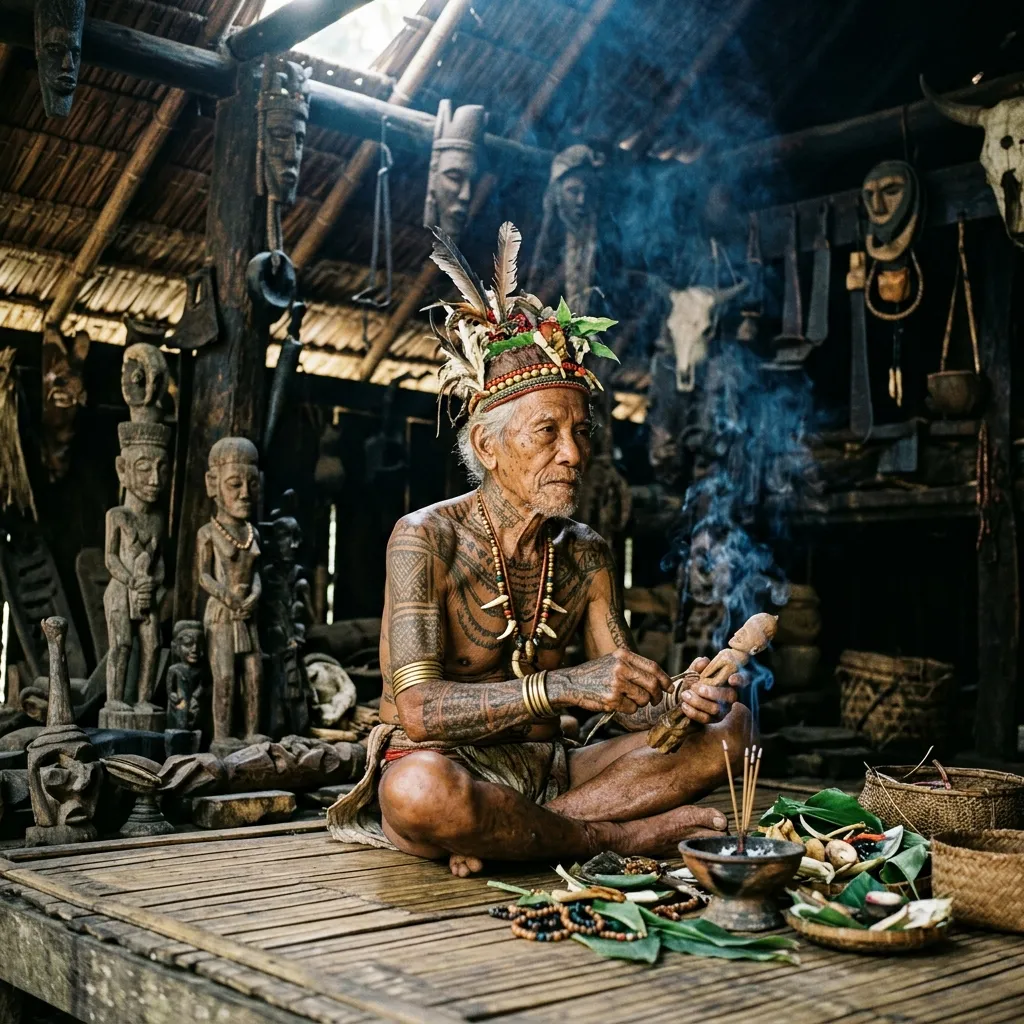
For decades, Indonesian state policy pressured the Mentawai people of Siberut Island to abandon Arat Sabulungan. The practice was restricted; ceremonial objects were confiscated. The Sikerei—shaman-healers whose knowledge holds the system together—persisted.
During a nighttime healing ceremony in the interior of Siberut Island, a Sikerei—a traditional shaman-healer—begins singing the urai kerei. The ancient chants, accompanied by the rhythm of a stretched lizard-skin drum, are directed at the simagere (the soul). In the Mentawai worldview, physical illness often signifies that a person's soul has wandered from the body, and the Sikerei's task is to negotiate its safe return.
For the community present, this is not a theatrical performance. It is a vital effort for survival. Yet, for decades, this exact practice was the target of a systematic campaign of state suppression—a campaign that fundamentally altered how the Mentawai people live, build, and pray.
1954: When Arat Sabulungan Became a State Target
The pressure on the Mentawai belief system reached a critical turning point in 1954. In what became known as the "Three Religions Meeting" (Rapat Tiga Agama), state authorities, alongside leaders of officially recognized religions, convened in the Mentawai Islands. The resulting mandate pressured the indigenous population to abandon their traditional faith and register under a state-sanctioned religion.
As documented by anthropologist Maskota Delfi in her study of religion in Mentawai, this was not a gentle theological shift. Ceremonial objects and talismanic bundles were confiscated and burned. The practice of Arat Sabulungan—the belief system that bound the community to the forest, the ancestors, and the spirits—was actively suppressed. The policy placed Sikerei and Arat Sabulungan practices in direct opposition to the state's agenda of national integration and modernization.
What Was at Stake: The Sikerei and the Uma
To understand what the government was dismantling, one must understand the social fabric of Siberut. The Sikerei are not a separate, untouchable caste. They are egalitarian community members who, through a grueling initiation, acquire the knowledge to mediate between the physical and spiritual worlds. Their extensive geometric tattoos (titi) serve as a visible record of this spiritual standing, believed to ensure recognition by ancestors in the afterlife.
Historically, the center of this world was the Uma—a vast, communal longhouse elevated on wooden pylons. As documented by Swiss anthropologist Reimar Schefold in the late 1960s, the Uma was more than a residential structure. It was the political, social, and ritual heart of a patrilineal clan. Several nuclear families shared the space, making collective decisions around the central hearth (abut kerei), where the Sikerei also performed purifications.
When the state intervened, it did not merely ban rituals. When the Uma lost its communal function, what unravelled was not merely a residential structure, but the social architecture of Mentawai society.
The New Order: Structural Disruption
The suppression intensified during the New Order era (1966–1998) through the PKMT (Resettlement of Isolated Communities) programs. Families were relocated from dispersed interior river valleys into strictly gridded, government-built coastal villages.
The impact went far beyond physical relocation. Communal Uma living was heavily discouraged in favor of single-family housing. Traditional markers of identity, such as tattooing and teeth-filing, were prohibited in the new administrative villages. When the community was fractured into individual households, the communal governance and intergenerational transmission of knowledge that the Uma facilitated were severely compromised.
The Tourism Paradox: Who Defines the Sikerei?
Today, Arat Sabulungan has not disappeared. It survived—sometimes practiced quietly in the deep interior, sometimes syncretized with official religions. However, the Sikerei now face a fundamentally different kind of pressure.
As indigenous scholar Juniator Tulius notes, the modernization of Siberut has introduced new choices. The younger generation now faces choices between formal education, wage labor, migration, and traditional life. Meanwhile, the very state mechanisms that once sought to erase Mentawai culture now promote it as a prime commodity for global ecotourism.
This creates a striking paradox. Foreign travelers pay significant fees to trek into the jungle and photograph the Sikerei. In this modern transaction, the traditional healer is frequently reframed as an exotic performer, catering to the expectations of outsiders. The pressure has changed: if the Sikerei were once suppressed by the state, their image is now increasingly shaped by what tourists expect to see.
Frequently Asked Questions
What is Arat Sabulungan?
Arat Sabulungan is the traditional belief system of the Mentawai people of Siberut Island. It holds that humans, animals, plants, and objects share a common spiritual dimension. Central to this system is the simagere (soul), which can wander from the body and must be cared for through ritual. The Sikerei—shaman-healers—are the primary practitioners responsible for managing this relationship between the community and the spiritual world.
What did the 1954 policy actually do to the Mentawai?
In 1954, a state-convened 'Three Religions Meeting' in the Mentawai Islands pressured the local population to register under one of Indonesia's officially recognized religions (Protestant, Catholic, or Islam) and stop practicing Arat Sabulungan. This led to the confiscation and destruction of ceremonial objects and the suppression of Sikerei practices. The second wave came during the New Order era (1966–1998) via PKMT resettlement programs, which relocated interior communities to coastal villages and prohibited traditional practices including tattooing and communal longhouse living.