Obon: When Japan Welcomes the Dead Home
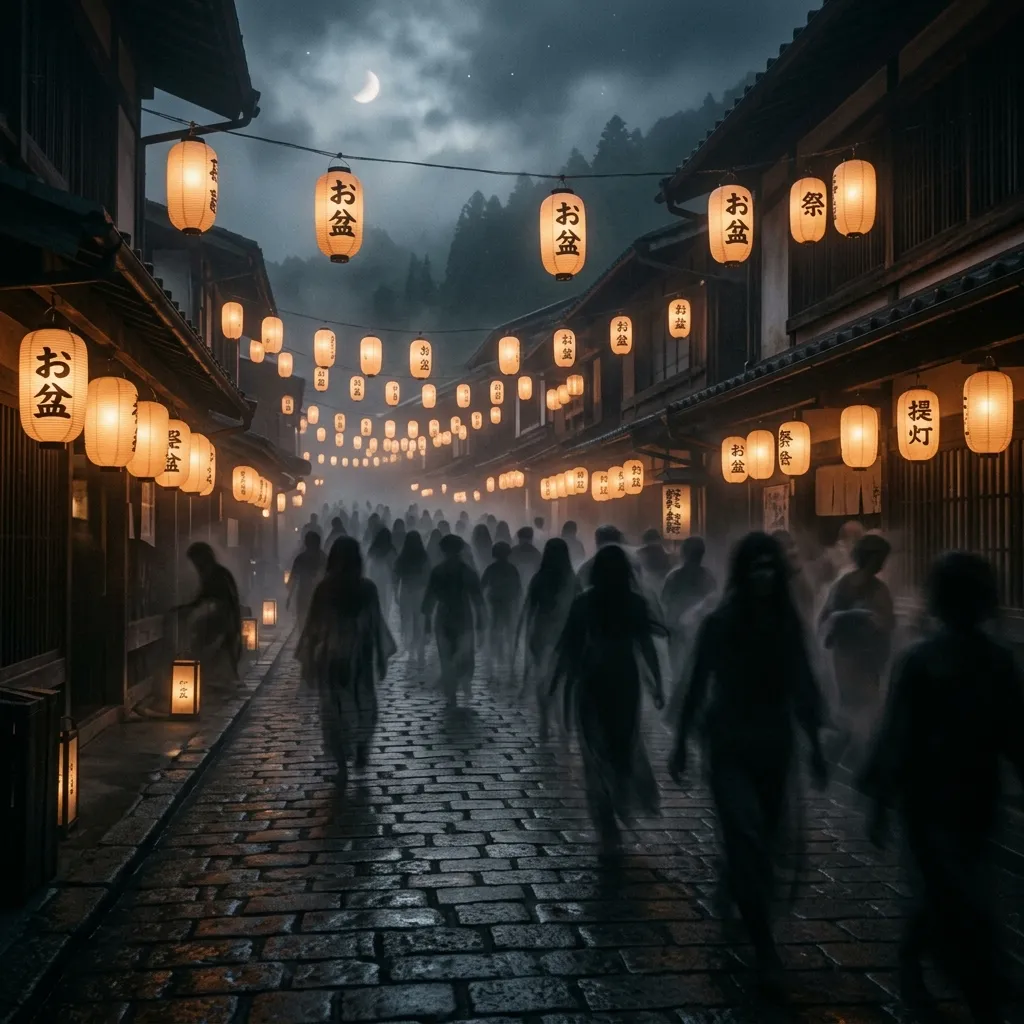
Discover Japan's Obon festival, when ancestral spirits are welcomed home through offerings, Bon Odori dances, traditional welcoming fires, and regional send-off rituals.
Obon is shaped less by fear of the dead than by an elaborate tradition of welcoming them home. Commonly observed in mid-August, though dates vary by region, the festival is one of Japan's most visible annual expressions of ancestral remembrance. In traditional Obon belief, ancestral spirits are welcomed back to the family home for a brief visit before being ceremonially sent away again. Obon turns remembrance into a ritualized visit: ancestors are welcomed, hosted, commemorated, and sent away again—with regional traditions giving that idea radically different forms.
Preparations often include cleaning family graves, making offerings, and preparing the household altar. At many graves, families leave flowers and incense. These preparations ready both the grave and the household for the period of remembrance.
The Welcoming Fire
Many Obon customs are structured around arrival and departure. The dead must navigate from wherever they rest to the homes they once inhabited. To guide them, in communities that observe the August 13–16 calendar, the mukae-bi (welcoming fire) is lit at the household gate on the evening of August 13th. Mukaebi may be made by burning dried hemp stalks (ogara) near the entrance to the home. Its light operates as an orientation beacon, offering the recognizable warmth of home and helping returning ancestors find their way home.
Within the household, the butsudan (family altar) is opened and elaborately prepared. The family constructs shōryō-uma—spirit horses made by piercing cucumbers with wooden chopsticks, and spirit cows made from eggplants. The cucumber horse and eggplant cow are commonly interpreted as allowing the ancestors to return quickly and ensuring a slow, lingering departure, respectively. Families may also place food and seasonal offerings before the altar.
Dancing in the Shadows of Akita
One of Obon's most visible public traditions is Bon Odori, a family of communal dances performed in communities across Japan. Bon dances vary enormously by region, from exuberant public celebrations to forms that retain a strong memorial association with the dead. Bon Odori generally does not require dancers to represent the dead. Nishimonai, however, takes the association with the dead in an unusually visual direction.
This ambiguity reaches its peak in Ugo, Akita Prefecture, during the Nishimonai Bon Odori. Here, musicians play by feel and memory while dancers move in a hypnotic circle. Many performers wear Hikosa Zukin—black hoods that completely conceal their faces—or deep semi-circular straw hats called amigasa. The covered faces evoke the dead so strongly that official descriptions liken the scene to ghosts dancing.
Japanese folklorist Yanagita Kunio famously interpreted Japanese ancestor observances through the lens of older indigenous ideas about ancestral spirits, emphasizing their continuing relationship with descendants. Yanagita connected ancestor belief with older rural and agricultural ideas in which ancestral spirits remained involved in the continuity and well-being of the household. In Yanagita's interpretation, ancestral spirits remain connected to the fortunes and continuity of their descendants rather than becoming wholly detached from the household.
The River of Departure
The final night of the festival is marked by the okuri-bi (sending fire), signifying the formal end of the visitation. In Kyoto, this takes the massive form of the Gozan no Okuribi, where giant bonfires forming characters and symbols are ignited on five mountains surrounding the city. Down in the valleys and coastal towns, the send-off takes other forms. In some communities, during the toro nagashi ceremony, families float paper lanterns down rivers or out to sea to guide the dead back to their resting place.
The imagery can feel less like a final farewell than a temporary parting. The house returns to ordinary use. Seen this way, the lanterns drifting slowly across the dark water suggest not a final separation, but an interval before another seasonal return.
Frequently Asked Questions
When is the Obon festival and where is the best place to experience it?
Most regions observe Obon around August 13–16, although some use July dates. For major public traditions, Tokushima's Awa Odori, Gifu's Gujō Odori, Akita's Nishimonai Bon Odori, and Kyoto's Gozan Okuribi offer very different expressions of the season.
Can visitors participate in Bon Odori dancing?
At many public Bon Odori events, yes. Gujō Odori in Gifu, for example, is particularly known for welcoming visitors and inexperienced dancers.
What is toro nagashi during Obon?
Toro nagashi is a lantern floating ritual observed by some communities to guide ancestral spirits back to their world at the end of Obon. Locations vary by region, and it should not be confused with the famous Hiroshima lantern floating, which is specifically a peace memorial event held on August 6.