Yamabushi Ascetics: The Rigorous Shugendo Practices of Dewa Sanzan
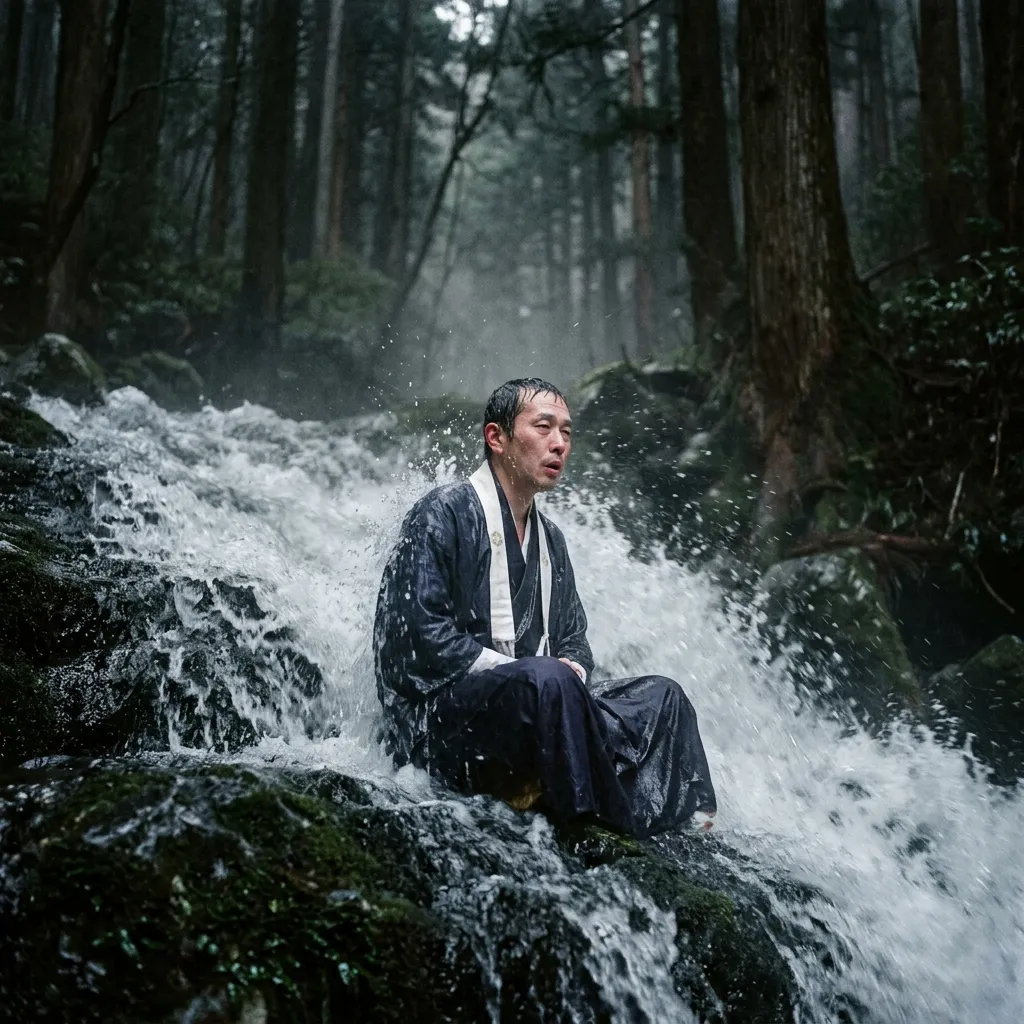
Examine the rigorous ascetic practices of the Yamabushi, from cold-water purification to symbolic rebirth rituals in Japan's northern mountains.
In the dense forests of Yamagata Prefecture, the three sacred peaks of Dewa Sanzan serve as a historical center for one of Japan's most demanding religious traditions. This is the domain of the Yamabushi, practitioners of Shugendō. Shugendō is a syncretic religion that blends ancient Shinto mountain worship with esoteric Buddhist cosmology. Rather than seeking spiritual progression solely through quiet contemplation, the Yamabushi engage in austere physical practices in the natural environment, utilizing the harshness of the mountains as a means of religious discipline.
When a practitioner embarks on the mountain entry ritual (nyūbu), they wear the shiroshōzoku, a plain white cotton robe. As scholar Hitoshi Miyake details in Shugendō: Essays on the Structure of Japanese Religion, this garment functions as a burial shroud. By wearing it, the ascetic symbolically dies to the secular world, preparing to be reborn through the trials of the mountain.
Austerity and Purification
One of the most recognized elements of their training is takigyō, or waterfall asceticism. Practitioners stand beneath mountain cascades, chanting sutras while the cold water pounds against them. In her anthropological study The Catalpa Bow, Carmen Blacker places cold-water austerities within a broader ascetic regime of purification, sacred recitation, and the acquisition of spiritual power under severe physical conditions.
Fire plays an equally critical role in Shugendō rites. During the Saitō Goma ritual, a large ceremonial pyre is constructed outdoors. Once the flames subside, the ascetics participate in hi-watari, walking barefoot across the hot coals. Historically, hi-watari is understood as a demonstration of ascetic accomplishment as well as a rite of purification.
Another significant practice is the Akinomine (Autumn Peak) retreat. In the modern Dewa Sanzan Shrine tradition, Akinomine is held over seven days, combining demanding mountain asceticism with an elaborate ritual journey. As described by the Shrine, the retreat symbolizes the process of entering the womb, passing through the world of the living, experiencing death, and ultimately achieving spiritual rebirth.
The Mountain as a Mandala
The landscape itself serves as a foundational element of Shugendō. The Dewa Sanzan mountains—Haguro, Gassan, and Yudono—are conceptualized by practitioners as a vast physical mandala. Navigating the steep trails and narrow ridges is an active form of worship, where traversing the geography mirrors the progression through different spiritual realms.
During these retreats, practitioners also participate in the Nanban Ibushi, a ritual where they sit in a closed room filled with the smoke of burning rice bran and red peppers. It functions as a traditional ascetic endurance ritual, requiring immense patience and physical stamina to withstand the intense irritation.
Historically, certain mountain ascetics practiced severe dietary restrictions alongside their physical training. The most extreme form was mokujiki ("wood-eating"), an austere diet of nuts, roots, and pine bark. However, this was not standard practice for all Yamabushi. As noted in research on the region, mokujiki was primarily undertaken by specific historical ascetics—particularly the issei gyōnin associated with Mount Yudono. For these dedicated ascetics, the diet served as a profound religious commitment to detachment and purification. For ascetics pursuing sokushinbutsu, the resulting loss of body fat was also understood to aid bodily preservation.
Frequently Asked Questions
What is the historical purpose of Takigyo (waterfall asceticism)?
Historically, cold-water austerities were practiced by Yamabushi as part of a broader regime of purification, sacred recitation, and the cultivation of spiritual power.
Did all Yamabushi practice the wood-eating diet (mokujiki)?
No, the extreme mokujiki diet (eating nuts, roots, and pine bark) was specific to certain dedicated historical ascetics, particularly the issei gyōnin of Mount Yudono.
What is the meaning behind the Akinomine retreat?
In the modern Dewa Sanzan Shrine tradition, the seven-day Akinomine retreat is a structured ritual journey symbolizing a progression through symbolic death and eventual spiritual rebirth.