Ama Divers: The Freediving Women of the Shima Peninsula
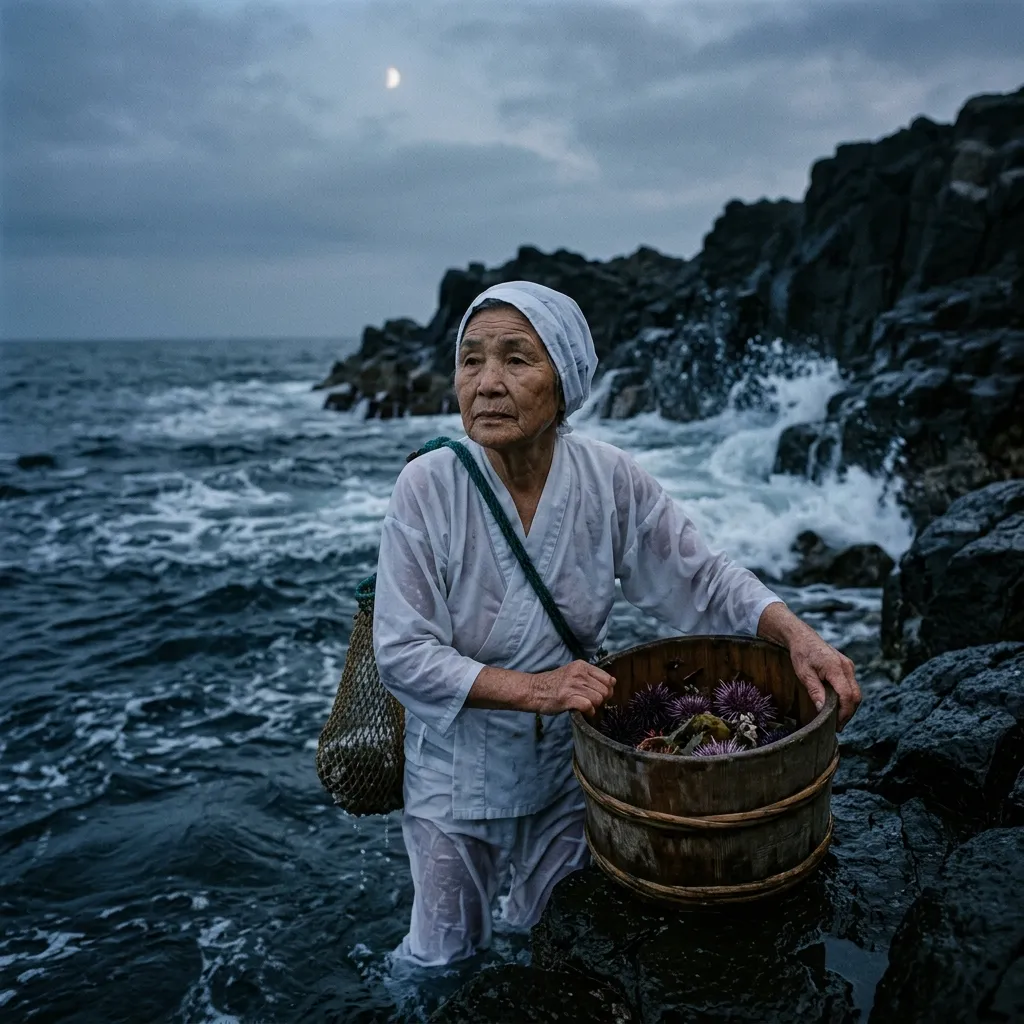
For generations, the Ama women of Mie Prefecture have free-dived into the ocean to harvest seafood. This is the history of their coastal traditions, physical endurance, and cultural survival.
The Pacific Ocean strikes the dark coastal rock of the Shima Peninsula with relentless force. In winter, the sea can become punishingly cold, yet generations of Ama have continued working these coastal waters. Ama diving in Japan is traditionally said to have a history of around 2,000 years. Working without modern air tanks, these freedivers plunge into the ocean armed only with a spatulate tool called an isogane, a wooden basket, and their own breath-holding ability.
Historical references to Ama appear in the eighth-century Man'yōshū poetry anthology, showing that female diving was already a recognizable part of coastal life. In the late nineteenth century, entrepreneur Kokichi Mikimoto employed Ama divers to manage oyster beds on Mikimoto Pearl Island, linking their practice with the global cultured pearl industry. Their association with Mikimoto made "pearl diver" the label most familiar abroad, but pearls were never the whole story: Ama were first and foremost coastal harvesters of abalone, shellfish, seaweed, and other marine resources. Despite this commercial evolution, the defining feature—breath-hold diving without air tanks—remained.
The Realities of Coastal Labor
Ama diving has historically been a female-dominated occupation and an important source of income for many coastal households. One frequently cited explanation for the historical predominance of women is thermal physiology: women on average carry more subcutaneous fat, which can improve insulation in cold water. But physiology alone does not explain the tradition; coastal labor patterns and social organization also shaped who became Ama, allowing women to remain submerged and harvest marine resources while in some communities men more often handled boats, fishing work, or agriculture.
Before wetsuits became common around the 1970s, Ama often worked in remarkably minimal clothing, with regional styles including white loincloths (fundoshi), shirts, headscarves (tenugui), and gloves. Ama harvesting in Toba and Shima remains breath-hold based, with local fisheries rules restricting the use of breathing apparatus and regulating seasons, catch size, and fishing grounds to limit pressure on marine resources.
The Mechanics of the Descent
When an Ama slips beneath the surface, she enters an environment of increasing water pressure and rapidly fading light. Down on the ocean floor, often several meters deep, with experienced Ama sometimes working at depths approaching 20 meters, the diver locates her target. Using the isogane, she must pry stubbornly clinging abalone from the rocks. It is an exercise in leverage and endurance conducted while the body's internal clock demands oxygen.
Isobue: The Whistle After the Dive
After surfacing, Ama produce a characteristic whistling exhalation known as isobue (sea whistle), part of the breathing cycle used between repeated breath-hold dives. To the uninitiated, the chorus of surfacing Ama sounds like a mournful wail echoing across the water. The slow exhalation through pursed lips gives the whistle its distinctive sound as the divers recover before descending again.
Seiman, Doman, and Apotropaic Magic
The tools and garments of the Ama frequently bear protective symbols known as the seiman and doman. The seiman is a five-pointed star drawn with a single continuous line, while the doman is a lattice of nine intersecting lines. The symbols are traditionally associated with the names of Heian-period mystics Abe no Seimei and Ashiya Doman. The star's continuous line symbolizes a safe return to the starting point, while the lattice was used as a protective mark against harmful spirits, marked or stitched onto clothing to safeguard the diver while she worked in the dark.
The Amagoya Fire
After emerging from the sea, the divers gather in the amagoya, a wooden shoreline hut that serves as a meeting place for their community. A central fire is kept burning while the divers rest and warm themselves. The women sit in a circle, resting between dives and exchanging information about the sea and the day's catch. Today, the average age of an active diver is over 65. While some Ama communities and operators now supplement fishing income through amagoya tourism and cultural experiences, the core reality of the Ama remains rooted in physical labor, still governed by the rhythms and limits of the sea.
Frequently Asked Questions
Do Ama divers really dive without scuba tanks?
Yes. Ama are breath-hold divers and do not use scuba equipment for traditional harvesting. Local fisheries rules in Toba and Shima regulate diving methods, fishing seasons, catch sizes, and harvesting areas to limit pressure on marine resources.
Why do the Ama divers whistle when they surface?
The sound is called the 'isobue' or sea whistle. It is an integral part of their recovery breathing. The slow exhalation through pursed lips gives the whistle its distinctive sound as the divers recover before descending again.
Can tourists experience Ama diving?
Yes. Some organized experiences in Toba allow visitors to enter the water with an Ama guide and try simplified traditional techniques under controlled conditions. This is different from joining licensed Ama at their commercial harvesting grounds.
Why are the numbers of Ama divers declining?
A national survey counted more than 17,000 Ama in the 1950s and roughly 2,000 by 2010. In Toba and Shima, a 2022 survey counted just over 500 active Ama. The decline reflects a combination of aging, limited recruitment, difficult working conditions, changing marine ecosystems, and reduced economic returns.