The Anabaptist Cages of Münster
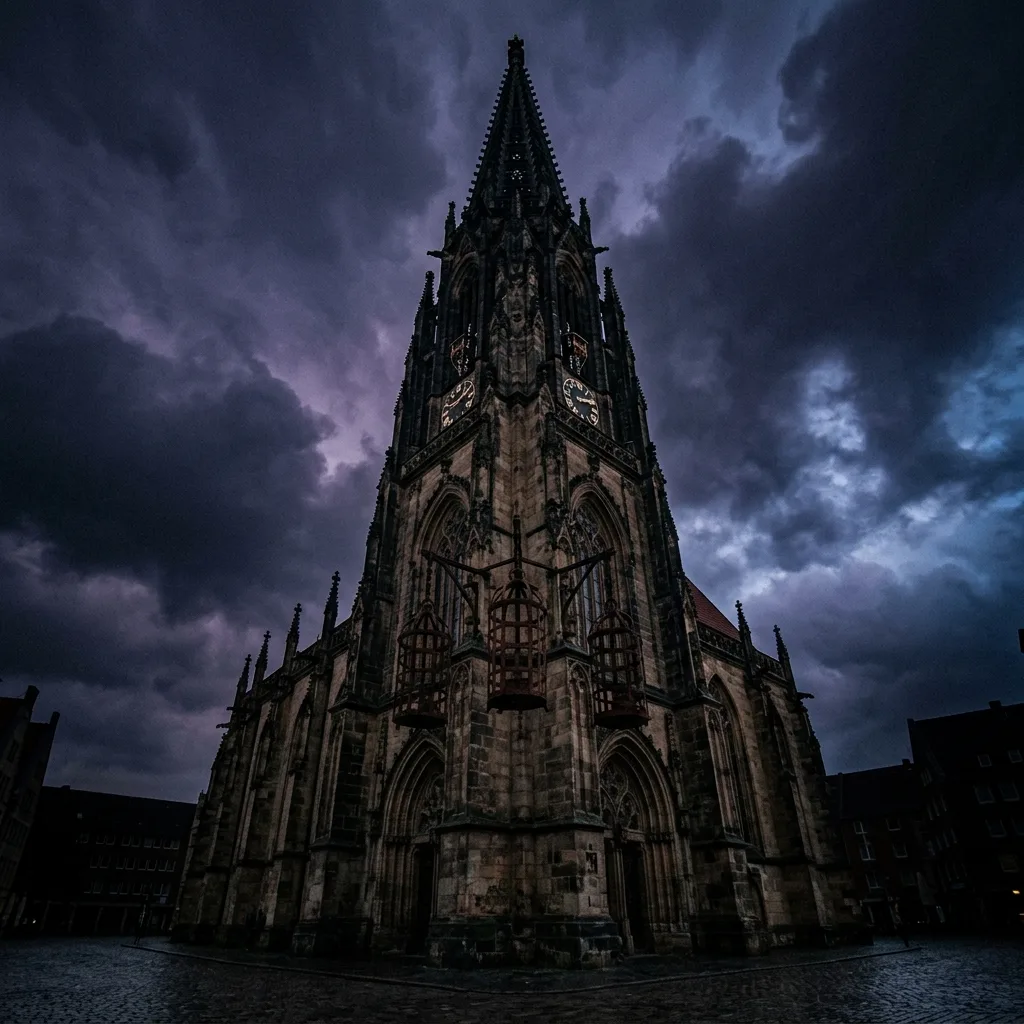
Three iron cages have hung from the steeple of St. Lambert's Church since 1536, forged to hold the executed leaders of a radical theocracy.
Suspended above the cobblestone streets of the Prinzipalmarkt in Münster, three rusted iron cages cling to the gothic spire of St. Lambert’s Church. These metal enclosures do not house church bells. They were forged in 1536 to hold the mutilated remains of three religious revolutionaries, hung from the tower as a permanent warning by the regional authorities.
The Radical Theocracy of 1534
The origins of the cages trace back to 1534, when a charismatic Dutch tailor named Jan van Leiden arrived in Münster. He brought a radical sect of Anabaptism that quickly overtook the local government. The sect expelled Catholics and moderate Protestants, declaring the city the "New Jerusalem." Within the fortified walls, Van Leiden crowned himself the monarch of this new theocracy. His administration abolished private property, enforced polygamy, and swiftly executed anyone who dissented.
Outside the walls, the exiled Prince-Bishop Franz von Waldeck laid a military siege. As the siege stretched into the winter of 1535, starvation set in. Residents survived on leather, stray animals, and roots scraped from the earth, while the leadership insisted that divine intervention would soon destroy the Prince-Bishop’s mercenary armies.
Execution in the Prinzipalmarkt
The collapse arrived through human betrayal rather than divine intervention. In June 1535, defectors opened the city gates, allowing the Prince-Bishop’s forces to recapture Münster. Jan van Leiden, his executioner Bernhard Knipperdolling, and his chancellor Bernhard Krechting were taken prisoner.
Historical accounts from chroniclers like Hermann von Kerssenbrock detail the severe punishment ordered by the victorious Prince-Bishop. On January 22, 1536, the three leaders were chained to poles in the Prinzipalmarkt, directly in front of the city hall. Executioners used heated iron tongs to tear flesh from their bodies for a full hour before driving daggers into their hearts.
The Legacy of the Cages
Following the execution, the three men were placed into custom-forged iron cages and hoisted to the top of St. Lambert’s Church. The bodies were left exposed to the elements and scavenging birds. For roughly fifty years, the skeletal remains remained visible until they finally disintegrated.
The structures proved highly enduring. When Allied incendiary bombs destroyed the church spire in 1944, local authorities recovered the twisted cages from the rubble. They were repaired and re-hung when the tower was rebuilt in 1948. In 1987, artist Lothar Baumgarten installed three small amber bulbs inside the empty cages, which illuminate the rusted iron at night.
Today, the cages remain a fixture of Münster's skyline. The church also maintains the tradition of the Türmer (tower guard), who sounds a copper horn from the tower every half hour between 9:00 PM and midnight, echoing across the same square where the execution took place nearly five centuries ago.
Frequently Asked Questions
Are the original bones still in the cages?
No. The skeletal remains of the three men were left exposed to the elements and remained visible for roughly 50 years until they fully disintegrated. The cages have been empty for centuries.
Are these the exact original cages from 1536?
Yes. While the church tower was destroyed during World War II bombings in 1944, local authorities recovered the twisted original iron cages from the rubble, repaired them, and re-hung them when the tower was rebuilt.
Can visitors access the tower to see the cages up close?
The church tower itself is not generally open for public climbing to reach the cages. However, they hang prominently on the exterior and are highly visible from the Prinzipalmarkt square below.