Ushi no Koku Mairi: How Japan's Hour of the Ox Curse Evolved
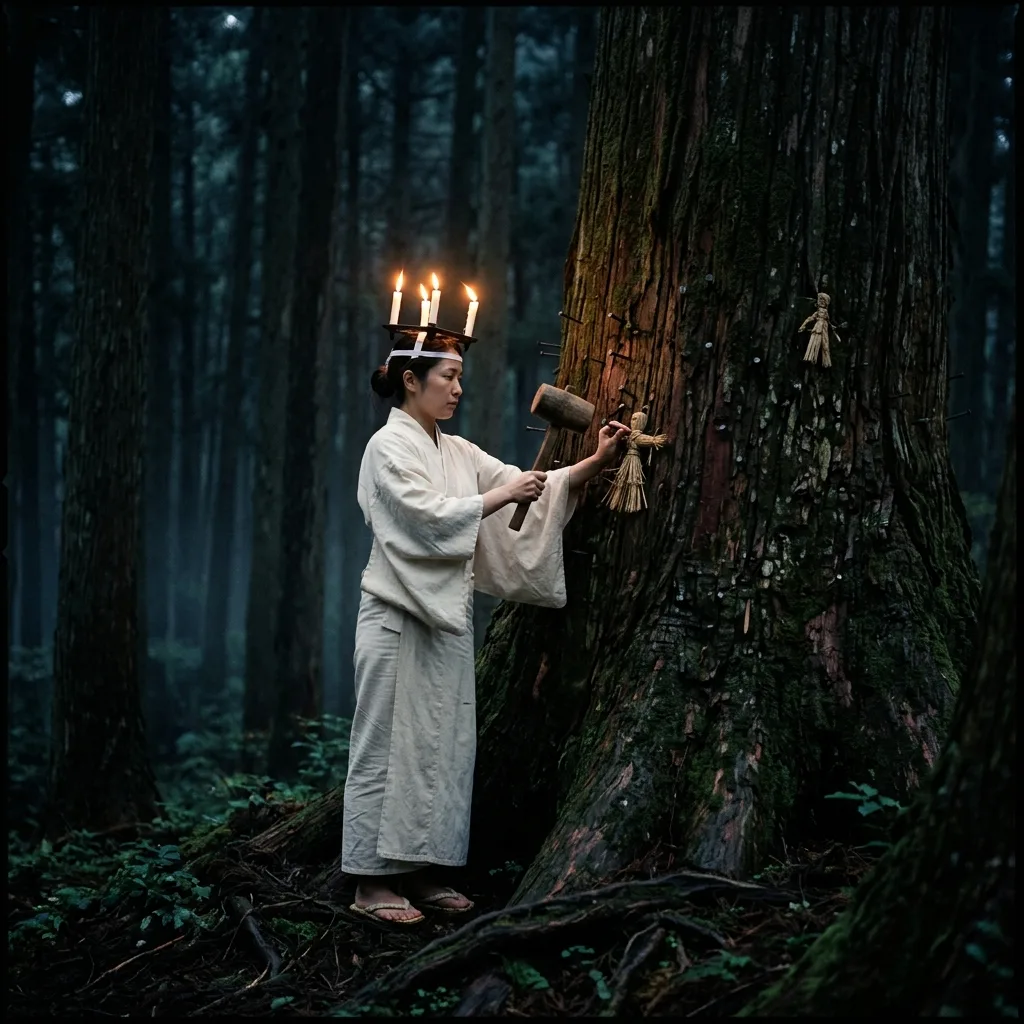
Explore how Ushi no Koku Mairi evolved from medieval legends of jealousy and demonic transformation into one of Japan’s most recognizable images of supernatural vengeance.
In Japanese folklore, few practices are as evocative as Ushi no Koku Mairi (often called Ushi no Toki Mairi), the Shrine Visit at the Hour of the Ox. In one of the best-known modern formulations of the legend, the ritual is presented as an elaborate sequence of vengeance: a practitioner walks into a dark forest during the Hour of the Ox, conventionally placed deep in the night around 2:00 AM, for seven consecutive nights, carrying a humanoid straw doll (wara ningyo). They forcefully drive a gosun-kugi, a long iron nail traditionally described as five sun (roughly 15 centimeters), through the effigy's chest and into a sacred tree (shinboku).
This terrifying visual, however, is not a single, unbroken ancient tradition. Rather, the imagery associated with the ritual is the result of centuries of accumulated folklore, literature, and artistic adaptation.
The Traditions of Hashihime and Kanawa
The ritual's imagery draws on overlapping medieval traditions of female jealousy, demonic transformation, Kifune Shrine, and the Uji Hashihime legend. According to medieval texts like the Tsurugi no Maki variant of the Tale of the Heike, a woman consumed by jealousy prayed at Kifune to become a living demon. She was instructed to paint her face and body red, wear a tripod with burning torches on her head, and immerse herself in the Uji River. This tradition contributed the motifs of red attire and river immersion to the later body of legends surrounding the curse.
Related motifs later appeared prominently in the Noh play Kanawa (The Iron Crown). In the play, a betrayed wife visits Kifune Shrine, where a priest receives a divine message instructing the woman to wear an inverted iron trivet (kanawa or gotoku) on her head with burning candles. While the overlapping legends cemented Kifune Shrine as a legendary focal point for the curse and introduced the terrifying imagery of the iron crown of fire, the literary traditions involved distinct narrative structures whose motifs were later layered together in popular representations.
Edo Period Iconography and Evolution
During the Edo period, the visual representation of the ritual evolved significantly. Ukiyo-e prints and kabuki performances helped circulate the imagery, leading toward the aesthetic recognized today. In many later popular representations, the practitioner appears dressed in white, contributing to the visual formula now commonly associated with the ritual.
How the Familiar Ritual Took Shape
The evolution of the curse's iconography demonstrates how disparate elements gradually merged into a standardized popular image. Later representations increasingly combined different elements, including white clothing, shrine visits, the iron trivet, and the act of driving nails into a tree. The iron trivet appears prominently in Kanawa, while the act of nailing an effigy to a tree became a documented staple of Edo iconography. Yet, even then, the visual formula was not entirely fixed. A 1765 design by Suzuki Harunobu, preserved in impressions at the Metropolitan Museum of Art and British Museum, depicts the practitioner carrying nails and a hammer but omits both the straw effigy and the iron crown.
Social Function and Modern Echoes
In popular narrative and iconography, the practitioner of the curse is often depicted as a betrayed woman. The recurring image of the betrayed woman can also be read against the gender hierarchies of premodern Japan. In folklore, supernatural retaliation offered a narrative language through which jealousy, abandonment, and otherwise constrained anger could be imagined as power.
The Hour of the Ox fell deep in the night and acquired ominous supernatural associations in Japanese folklore. Some traditions specifically emphasize ushi no mitsu doki—the 'third quarter of the ox' (around 2:00 to 2:30 AM)—as the most ominous time for the ritual. Secrecy is another recurring element: many versions insist that the ritual must remain unseen; being witnessed may cause the curse to fail or, in some retellings, rebound upon the practitioner. In folkloric imagination, this secrecy placed the practitioner alone in the darkness of shrine grounds and mountain paths.
While modern reports of wara ningyo found nailed to trees still occasionally appear in popular media, these contemporary incidents should be distinguished from historical records. Ultimately, the enduring fascination with Ushi no Koku Mairi lies not just in its supernatural elements, but in its complex evolution—a ritualized expression of profound human emotion constructed layer by layer over centuries of storytelling.
Frequently Asked Questions
Why is Kifune Shrine associated with Ushi no Koku Mairi?
Kifune Shrine is strongly associated with Ushi no Koku Mairi in literary and folkloric tradition, particularly through stories of jealous women seeking supernatural intervention. This should not be confused with the shrine's contemporary religious identity or purpose as a prominent site for water deities and matchmaking.
What does 'Wara Ningyo' mean?
Wara ningyo means 'straw doll.' In many popular versions of Ushi no Koku Mairi, it serves as an effigy representing the intended target, although historical depictions do not always include one.
Why is Ushi no Koku Mairi associated with 2 AM?
The Hour of the Ox broadly refers to the period between 1:00 AM and 3:00 AM. Some traditions specifically emphasize ushi no mitsu doki, the 'third quarter of the ox' (around 2:00 to 2:30 AM), as the most ominous time for the ritual.