Sokushinbutsu: The Ascetics Who Mummified Themselves Alive
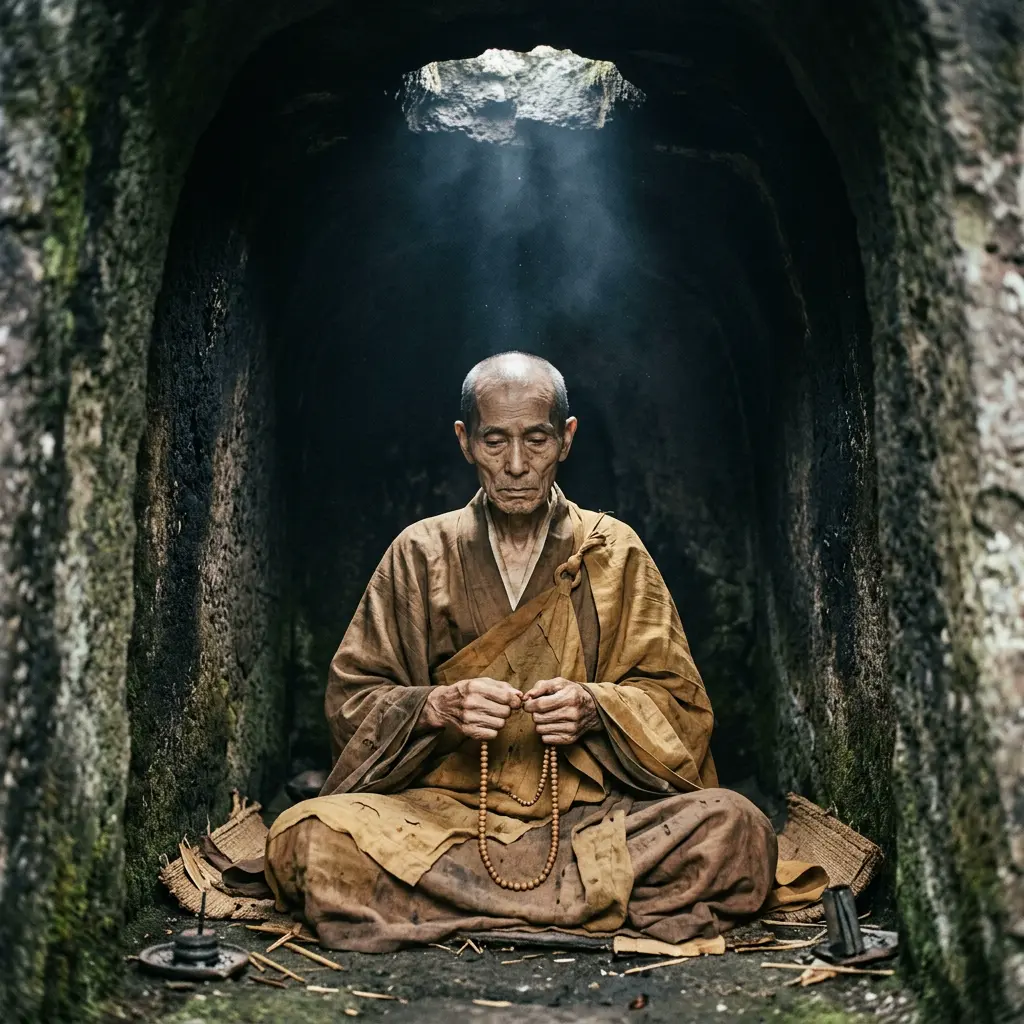
Deep in the mountains of Yamagata, a secretive sect of monks underwent years of extreme dietary restriction and subterranean confinement to turn their own bodies into incorruptible relics.
In the remote Dewa Sanzan mountains of Yamagata Prefecture, glass cases inside temples like Dainichibo and Churenji house the leathery, skeletal remains of Shugendo monks. Dressed in ornate robes and seated in eternal lotus positions, these figures are not victims of natural mummification. They are sokushinbutsu—monks who, according to local temple records, underwent a grueling multi-year process of self-mummification while still alive.
Temple lore states that becoming a sokushinbutsu required a massive dismantling of the human metabolism. The process, known as mokujiki (wood-eating), traditionally demanded a thousand days of abstaining from all grains. Monks survived on nuts, seeds, and berries foraged from the mountain slopes, systematically stripping the body of fat. A subsequent thousand-day cycle restricted the diet further to pine needles and bark, reducing the monk to a living skeleton.
According to Shugendo tradition, to repel maggots and accelerate dehydration, the ascetic would begin drinking a toxic tea brewed from the sap of the urushi tree—the same highly poisonous sap used in traditional Japanese lacquerware. This induced severe vomiting and urination, effectively lacquering the digestive tract from the inside and rendering the flesh inhospitable to bacteria.
The Subterranean Chamber
The most infamous phase of the legend involves the final confinement. Temple narratives claim the ascetic would voluntarily enter a narrow stone chamber deep underground, equipped only with a bamboo tube for air and a small bell. Each day, the monk would ring the bell to signal his continued survival. When the ringing eventually stopped, disciples would remove the bamboo tube and seal the tomb completely. After a thousand days, the grave was opened. If the body was found preserved, the monk was venerated as a sokushinbutsu; if decayed, he was resealed and respected merely for his endurance.
While this claustrophobic narrative is a cornerstone of Yamagata's religious folklore, medical investigations have introduced complications to the legend. In the 1960s, researchers from Niigata University conducted extensive examinations of several sokushinbutsu. While they confirmed severe pre-mortem starvation, they also found evidence of post-mortem interventions.
Medical Reality vs. Temple Lore
Scholars like Kosei Ando and the Niigata researchers discovered that natural preservation alone, even after the grueling mokujiki diet, was rarely sufficient in Japan's humid climate. Evidence suggests that surviving disciples frequently assisted the preservation process after the monk's death. Bodies were often dried using charcoal or incense smoke in specialized drying houses, and some cavities were packed with preserving materials.
This physical evidence does not erase the staggering reality of the ascetics' pre-mortem suffering, but it shifts the narrative. The creation of a sokushinbutsu was likely a collaborative effort between the dying monk, whose starvation laid the biological groundwork, and his disciples, who ensured the preservation was successful.
Today, viewing figures like Shinnyokai Shonin—who achieved sokushinbutsu at Dainichibo in 1783—offers a grounding confrontation with extreme religious devotion. The body sits rigidly in the dim light of the temple hall, the dark skin stretched tight over the skull. The focus is no longer on the supernatural impossibility of a man willing himself into a mummy, but on the severe material reality of a community that believed enlightenment required starving the body into a state of permanent architectural stillness.
Frequently Asked Questions
Can you see a Sokushinbutsu in person?
Yes. Several temples in Yamagata Prefecture, notably Dainichibo and Churenji, respectfully display the preserved remains of their ascetics for visitors.
Is self-mummification still practiced in Japan?
No. The Meiji government criminalized practices like opening the graves of these monks in the late 19th century, effectively bringing the tradition to a close.
Why did the monks drink urushi sap?
According to tradition, tea made from the toxic urushi tree sap induced vomiting to expel moisture and made the body toxic to decomposing organisms.