Iceland's F-Roads: When the Road and Horizon Disappear
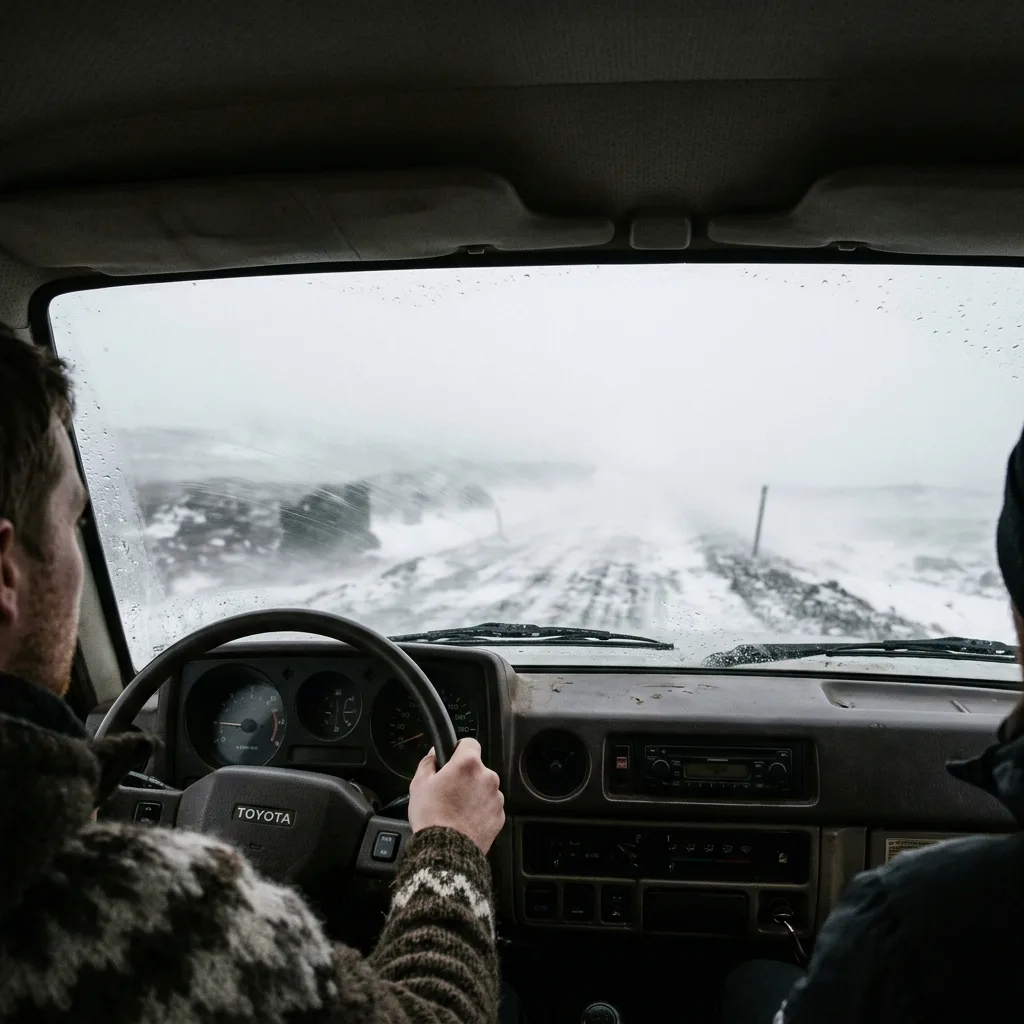
Driving in Iceland presents distinct hazards, from unbridged glacial rivers on summer-opened F-roads to winter whiteouts that can eliminate depth perception.
F-roads (Fjallvegur) are mountain roads that access Iceland's highland regions. Their conditions vary widely, from rough gravel surfaces to tracks that cross unbridged rivers. Most F-roads are only open seasonally, generally during the summer, with opening dates depending on road conditions. One of the primary hazards on these routes is the unbridged glacial river. The currents and conditions of glacial rivers can change rapidly, and the silt-heavy, cloudy water makes it difficult to see the depth or any large rocks on the riverbed. River conditions can shift, and a crossing should not be attempted if the depth, current, or route cannot be safely assessed. SafeTravel advises drivers to check current conditions and seek local advice before entering the highlands.
The Physics of a Whiteout
While F-roads present specific terrain challenges during their open season, a broader hazard across Iceland, particularly in winter, is the phenomenon of a whiteout. A whiteout is a meteorological condition where visual contrast and depth perception are completely eliminated. This typically happens when blowing snow, dense fog, or a severe blizzard causes the snow-covered ground to blend seamlessly with a white sky.
In a severe whiteout, the danger is not just the lack of visibility of the road ahead. The contrast between the ground, the sky, the snow, and the horizon can disappear entirely, causing the brain to lose its visual references for depth and orientation. Drivers may lose spatial awareness, making it difficult to distinguish the road surface from a snowbank or road edge. In a heavy whiteout, the loss of visual references can make driving extremely dangerous or impossible to do safely.
Why Road Conditions Matter More Than 4x4 Capabilities
A 4x4 vehicle does not automatically make driving in the highlands or in severe weather safe. Road, river, and weather conditions can change in a short time, making official information an essential part of trip preparation. Before departing, check the weather forecast from Veðurstofa Íslands (vedur.is) and road conditions from Vegagerðin (road.is).
When Vegagerðin (The Icelandic Road and Coastal Administration) marks a road as closed or impassable, drivers should not proceed. If Vegagerðin marks a road as closed or impassable, do not proceed. In the Icelandic highlands, a 4x4 expands where you can go. It does not change the weather, lower the rivers, or restore a horizon lost in a whiteout.
Frequently Asked Questions
Are 2WD cars allowed on F-roads?
F-roads are intended for vehicles suited to their conditions, and many rental companies prohibit 2WD vehicles on F-roads. Check the road classification and your rental company's vehicle and insurance terms before departing.
What should I do if I encounter a severe whiteout while driving?
SafeTravel advises that if you are caught in a severe whiteout, you should carefully stop the vehicle, turn on your hazard lights, and stay inside the car. Do not attempt to walk away from the vehicle to find help, as you can easily lose your orientation in the lack of visual references.
Who rescues travelers stuck in the highlands or extreme weather?
ICE-SAR (Slysavarnafélagið Landsbjörg) is Iceland's highly trained, volunteer-based search and rescue organization.