Oppenheim Ossuary: The Silent City of Bones
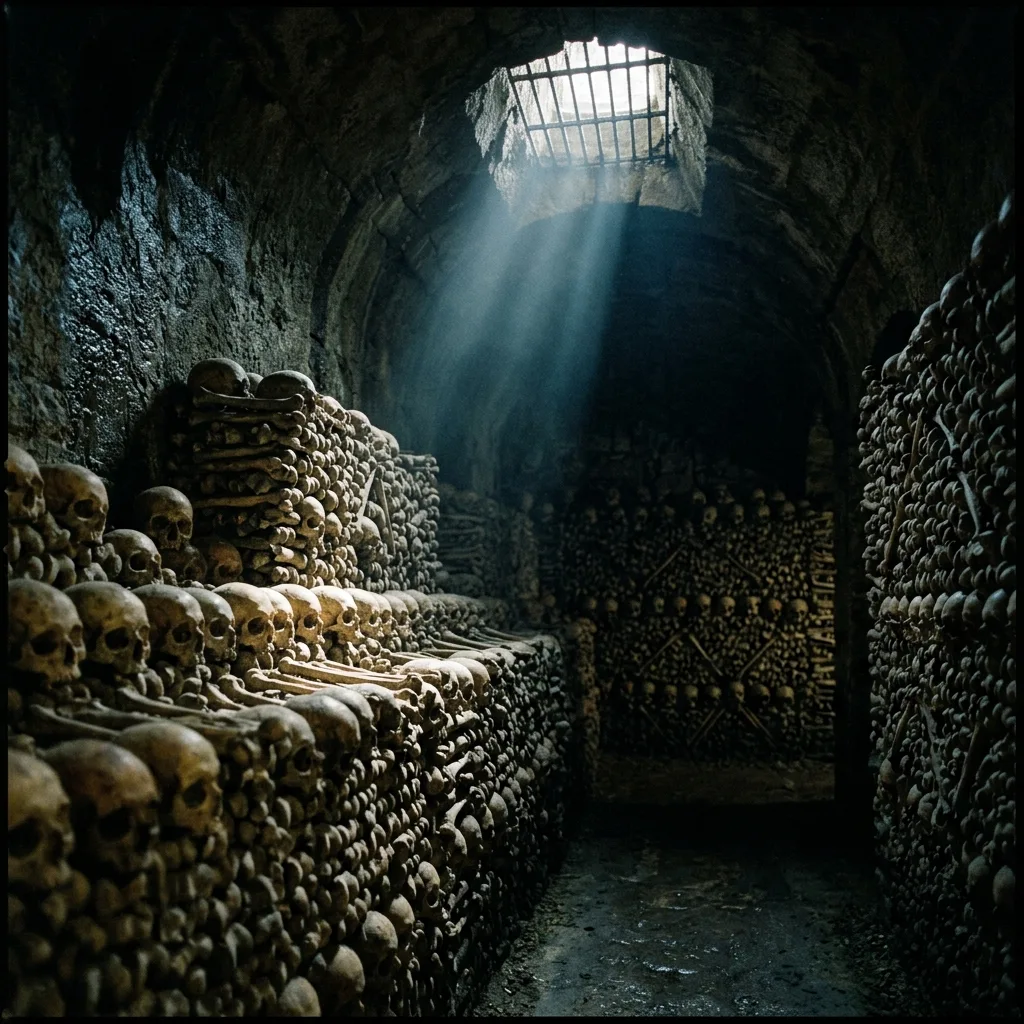
Hidden beneath a medieval church in a quiet German town lies a claustrophobic cellar housing the meticulously stacked remains of over 20,000 forgotten souls.
Beneath the half-timbered facades of Oppenheim lies an underground labyrinth composed entirely of human remains. The Michaelskapelle, a 14th-century gothic chapel attached to the Katharinenkirche, conceals an ossuary holding the bones of thousands of people. While visitors walk the vineyards above, a dimly lit basement below holds the stacked femurs, tibias, and skulls of an estimated 20,000 citizens.
The accumulation of bones was driven by the practical realities of medieval urban planning. Oppenheim was a prosperous trading hub on the Rhine River, enclosed by defensive walls. As the need for burial space increased, the Katharinenkirche churchyard eventually ran out of room. According to the 1905 historical monograph Die Oppenheimer Michaelskapelle by local archivist Carl Zumpe, the town gravediggers instituted a strict rotation system between the early 15th and late 18th centuries.
The Pragmatic Calculus of the Grave
Fresh corpses were buried for ten to fifteen years until the soft tissues decomposed. Once the graves were needed for the newly deceased, the skeletons of the previous occupants were exhumed. The bones were carried into the cellar beneath the Michaelskapelle and stacked against the damp walls. The remains of generations of Oppenheim residents were stored together in the cellar. Among them were victims of the Thirty Years' War.
The gravediggers arranged the bones to maximize storage efficiency rather than to honor individuals. Skulls were wedged tightly between neatly laid rows of long bones, creating structural walls that reached the vaulted ceilings. Over centuries, the weight of the upper layers gradually compacted the fragile bones at the bottom.
The Geography of Anonymous Bones
Thousands of skulls are stacked with the uniformity of masonry, obscuring the original stone walls. Unlike the decorated skulls of the Hallstatt Charnel House in Austria, the remains in Oppenheim bear no painted names or floral wreaths. They were simply placed in the dark and left to time. A faint light filters in through a high window, highlighting variations in bone coloration—ranging from bleached white to deep, soil-stained brown.
Today, a heavy iron grate prevents visitors from physically entering the stacks, limiting observation to a narrow viewing corridor. There are no polished granite headstones or eulogies. The cellar serves as a stark reminder of the city's medieval past.
Frequently Asked Questions
How can I visit the Oppenheim Ossuary?
The ossuary is located beneath the Katharinenkirche. You can view the bones through a metal grate during visiting hours, and guided tours offering deeper historical context are often available through the local tourist office.
Are the bones real?
Yes. The bones are authentic human remains from citizens of Oppenheim who died between the 15th and 18th centuries.
Is photography allowed inside?
Photography rules may vary. Please check the latest regulations at the entrance or with the local tourist office before taking photos, and always maintain a respectful demeanor.