Tsukumogami: Japan's Living Objects and the Night Parade
Explore the medieval Japanese tales behind tsukumogami—old tools said to gain spirit after a century—and how object-yōkai entered the Night Parade.
Internet lore often says every Japanese object becomes a tsukumogami—an animated, living object—at exactly one hundred years old. However, the historical reality is far stranger. A well-known medieval tale, the Tsukumogami-ki (Record of Tool Specters), says that utensils and tools reaching one hundred years can acquire a spirit and deceive humans. Rather than a universal rule of ancient animism, this hundred-year threshold was a specific literary formulation that eventually shaped how Japan imagined the supernatural agency of everyday things.
Unlike ghosts of human origin, these entities emerge from the mundane. The domestic nature of these object-yōkai means that the supernatural could emerge from inside the home. Modern popular culture often treats tsukumogami as a neat category of century-old object spirits, but historical texts were less systematic.
The Tale of the Discarded Tools
The most detailed historical account of this phenomenon is the Tsukumogami-ki scroll from the Muromachi period (1336–1573). The text describes a year-end cleaning in Kyoto. The scroll imagines households discarding old implements just before their hundredth year to prevent them from acquiring a spirit and causing trouble.
Angered at being discarded, the old tools gathered to plot their revenge. According to the text, the objects performed esoteric religious rituals to transform themselves into yōkai (supernatural creatures). The resulting horde included animated lutes, tattered umbrellas, and cracked mirrors.
When the Objects Joined the Night Parade
They then enter the capital in a revenge-driven procession. This procession belongs to the broader visual and narrative world of Hyakki Yagyō, the Night Parade of One Hundred Demons. The Night Parade is a major motif in yōkai culture, and the Tsukumogami-ki is just one representation of object-yōkai participating in it.
Folklorist Komatsu Kazuhiko notes that the scroll specifically locates this demonic procession along Ichijō Street in northern Kyoto. Today, Kyoto’s civic community continues to embrace this folklore, officially designating a section of the area as "Yokai Street" to celebrate the legend of the abandoned objects' parade.
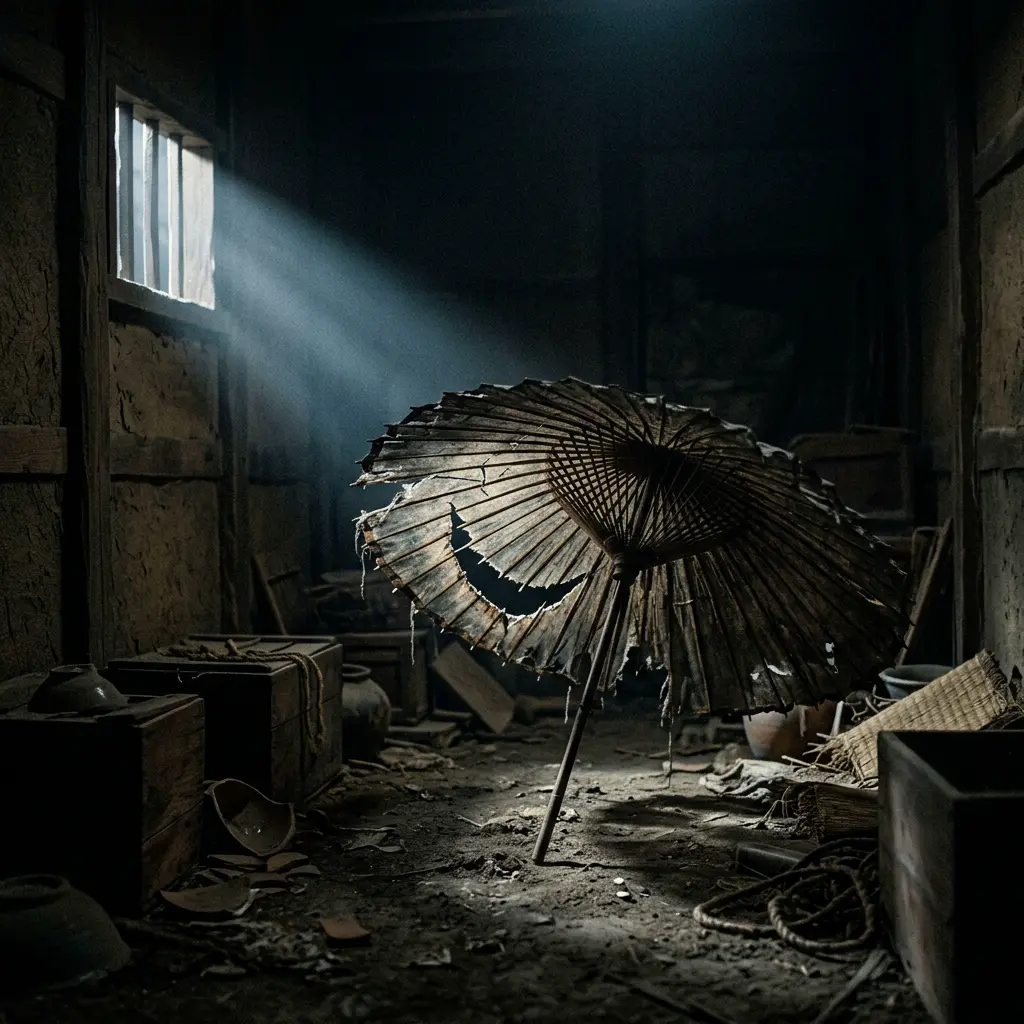
Specific objects developed their own distinct iconography within Japanese folklore. The kasa-obake is a heavily worn paper umbrella that hops on a single leg, featuring one eye and a long tongue. The chōchin-obake is often depicted as a paper lantern split open to reveal a mouth. These figures became familiar motifs in Edo-period yōkai art and illustrated books. Later object-yōkai such as umbrella and lantern ghosts are often grouped under the tsukumogami label today, even though historical classifications were not always so tidy.
From Vengeful Spirits to Buddhist Salvation
Modern retellings often focus solely on the objects' monstrous revenge, but the Tsukumogami-ki has a more complex structure. The story does not end with violence. Ultimately, the tale functions as a Buddhist salvation narrative. After causing disorder, the object-yōkai are confronted by religious rituals, leading them to abandon their anger, undergo religious transformation, and achieve Buddhist salvation.
The Separate Tradition of Memorializing Objects
Modern interpretations often read the tsukumogami legend as a warning against careless disposal and as a reminder to respect useful objects. That reading resonates strongly with the contemporary idea of mottainai (avoiding waste), though it should not be treated as the single historical function of the folklore.
A separate but related Japanese practice of ritually thanking or memorializing used objects can be seen in various forms of kuyō. Some objects are ritually memorialized at particular temples and shrines. During Hari-kuyō observances—often held on February 8 in eastern Japan and December 8 in western Japan—tailors and seamstresses embed broken needles into soft tofu or konnyaku.
The rite expresses gratitude to worn-out needles and often includes prayers for continued skill in sewing. These ceremonies ensure the objects are formally acknowledged, reflecting a cultural habit of thanking the physical environment for its utility.
Frequently Asked Questions
What kinds of objects appear as tsukumogami?
Medieval scrolls depict many utensils and tools becoming yōkai; later popular object-yōkai such as umbrella (kasa-obake) and lantern ghosts (chochin-obake) are often associated with the broader tsukumogami idea.
Are there Japanese memorial rituals for old objects?
Yes. Some temples and shrines hold kuyō rites for specific objects such as needles (Hari-kuyō) or dolls (Ningyo-kuyō). These rites express gratitude to the objects rather than merely disposing of them.
What happens in the Tsukumogami Emaki scroll?
The Muromachi-period scroll tells the story of discarded household tools that perform esoteric rituals to gain supernatural powers. They march on Kyoto in a revenge parade, but the story ultimately concludes with the objects achieving Buddhist salvation.