Kaidan-banashi: The Ghost Story Architects of Edo Japan
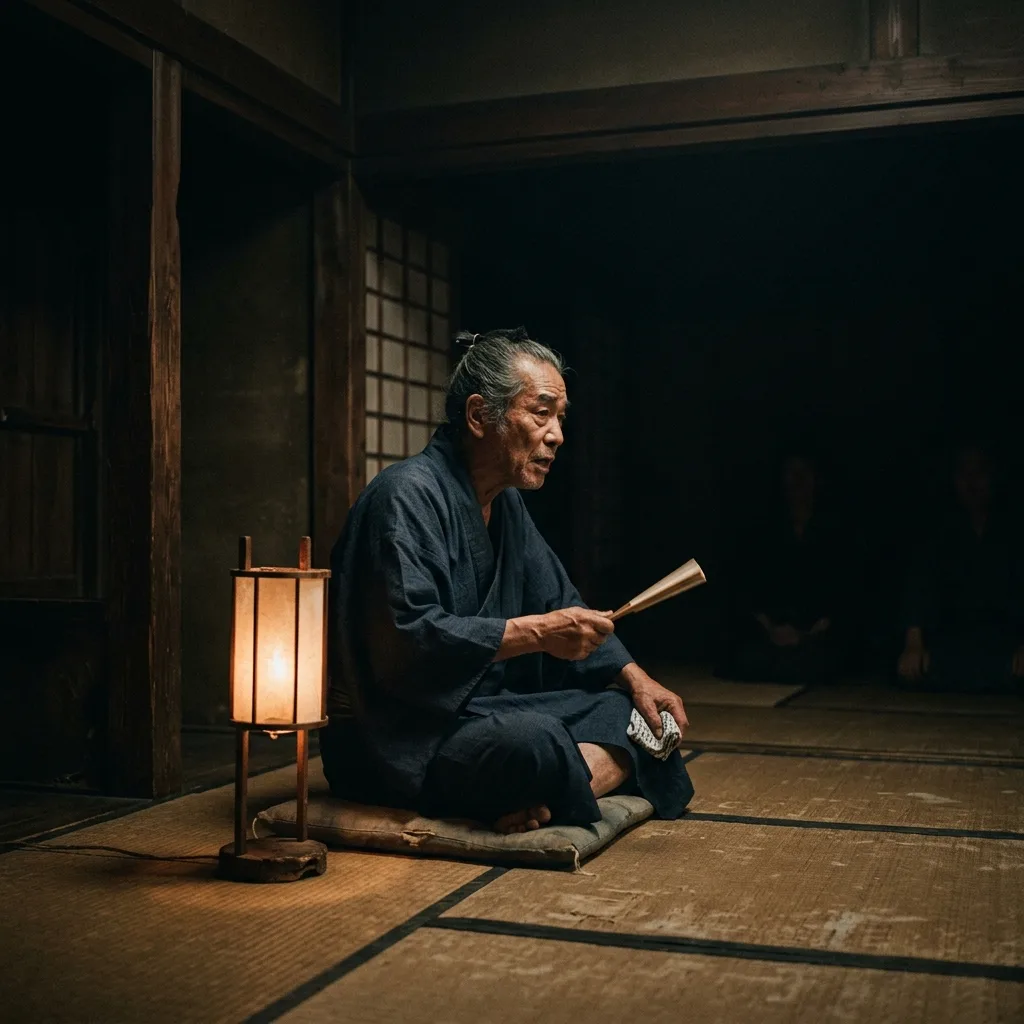
During Japan's Edo period, ghost-story performers used darkness, voice, sound, and anticipation to turn summer storytelling into an intensely physical experience.
During the sweltering summers of the 17th and 18th centuries, the Japanese ghost story (kaidan) could function almost like a form of psychological technology. Ueda Akinari's Ugetsu Monogatari, published in 1776, became one of the best-known literary collections associated with early modern Japanese supernatural fiction. Yet some of the genre's most visceral effects survived not on the printed page, but in oral performance. Ghost-story performers combined storytelling, darkness, sound, and anticipation in ways that made fear intensely physical.
One of the best-known social applications of this was the Hyakumonogatari Kaidankai (Gathering of One Hundred Supernatural Tales). As documented by scholar Noriko T. Reider, these were popular parlor games played at night. In its best-known form, participants prepared one hundred lights and extinguished one after each tale. As the room grew darker, the psychological tension escalated, culminating in total pitch blackness where, according to the game's supernatural premise, a spirit might appear.
The Architecture of Sensory Deprivation
The true masters of this tension were the professional storytellers who specialized in kaidan-banashi (ghost story performances). Their acoustic delivery could make the surrounding space itself feel uncertain.
The first weapon was the performance space itself. In an era before electric lighting, absolute darkness was profound. Storytellers exploited this limitation of vision. With fewer visual cues, small sounds could become unusually salient: a floorboard creaking, silk rustling, or another listener breathing nearby. The atmosphere did the heavy lifting before the story even reached its climax.
Hiyashi and the Mechanics of Cold
To heighten this physical dread, storytellers employed a concept related to hiyashi (cooling). Ghost stories became associated with summer cooling culture (suzumi), where the chill of fear offered a metaphorical—and perhaps felt—escape from the heat.
The acoustic delivery was equally sophisticated. Master practitioners also used techniques described as kage-goe (shadow voice), manipulating vocal presence to heighten the impression of a voice emerging from beyond the visible performer.
San'yūtei Enchō and the Professionalization of Fear
One of the most influential figures in the development of kaidan-banashi was San'yūtei Enchō in the late Edo and early Meiji periods. Enchō developed kaidan-banashi into elaborate psychological dramas built around character, pacing, and supernatural tension. As detailed by scholar M. Kinjō, his performances—such as the famous Botan Dōrō (The Peony Lantern)—relied heavily on his precise control of pacing and voice.
In Enchō's storytelling, some of the most effective horror came from implication. Many effective kaidan did not depend on revealing a monster immediately. Instead, they relied on maximum ambiguity: a sound at the sliding door that might be human or spectral, a figure in the peripheral vision, a sensation of being watched.
Hearn's Kwaidan (1904) helped introduce English-language readers to stories in which haunting often emerges from broken obligations, memory, attachment, and consequences that refuse to remain buried. In many of these tales, the boundary between victim, transgressor, and supernatural consequence is less straightforward than a simple binary of good and evil.
Today, echoes of kaidan-banashi remain visible in Japanese horror: delayed revelation, uncertain spaces, disembodied sound, and dread built through anticipation rather than immediate confrontation. The lingering dread of films like Hideo Nakata's The Ring serves as a modern example. Yet, the original art form of a solitary voice in the dark, methodically stripping away the listener's certainty, remains a unique chapter in the history of performance.
Frequently Asked Questions
What is the difference between kaidan and kwaidan?
Kaidan (怪談) is the standard modern romanization for traditional Japanese ghost stories. Kwaidan is an older romanization famously associated with Lafcadio Hearn's 1904 book, which helped introduce these tales to the English-speaking world.
What is the Hyakumonogatari Kaidankai?
The Hyakumonogatari Kaidankai (Gathering of One Hundred Supernatural Tales) was a popular Edo-period parlor game. Participants gathered 100 lights and told ghost stories, extinguishing one after each tale. The final darkness was traditionally associated with the possibility of a supernatural manifestation.
Can You Still Hear Kaidan-banashi Today?
Yes. While the intimate parlor game format is rare, Rakugo storytelling halls (Yose) occasionally host traditional kaidan-banashi performances, often featuring the classic works of San'yūtei Enchō. Some temples also hold kaidan events during the summer season.