How Bali's Tourist Scams Actually Work
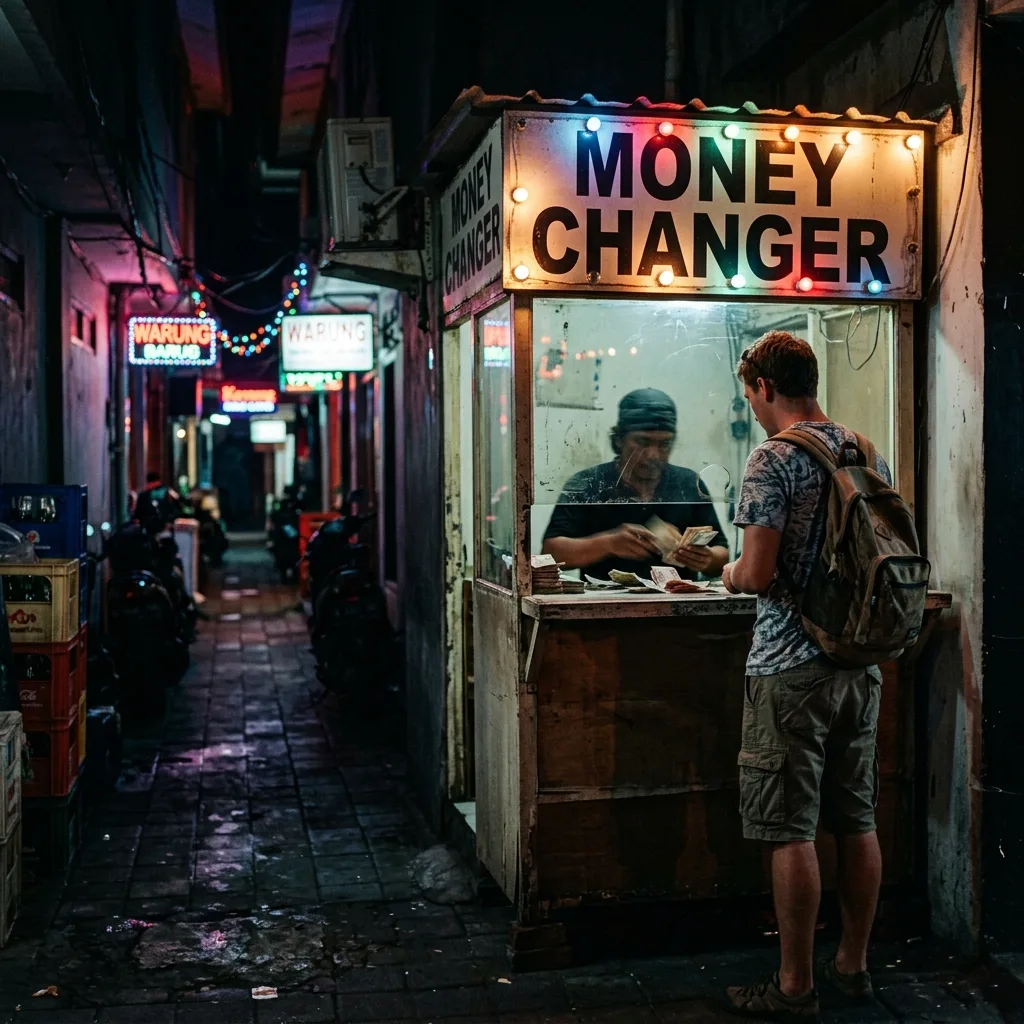
Three distinct tourist traps in Bali — unregulated money changers, unauthorized temple guides, and opaque transport fares — share the same operating principle: one side knows the local system, the other does not.
Three distinct tourist traps in Bali illustrate the same operating principle: one side understands the local system and the other does not. At informal currency exchange kiosks in Kuta, the gap is in rupiah denominations. At major temples, it is in religious protocol. At the airport, it is in fare pricing. In each case, the transaction succeeds not through force but through information the visitor does not yet have.
Among the currency exchange operators in Bali's tourist areas, some work without Bank Indonesia authorization as a KUPVA BB (Kegiatan Usaha Penukaran Valuta Asing Bukan Bank). An exchange rate that appears unusually favorable can draw visitors into a kiosk, but the legality of any money changer cannot be determined from its rate board alone.
How the Kuta Money Changer Actually Works
One documented pattern begins with intentional distraction. The operator distracts the customer while handling and handing over the money. The core technique, documented in Bank Indonesia consumer advisories and local complaint records, relies on a fast physical maneuver: the operator drops several large denomination bills behind the glass counter while simultaneously counting the remaining cash in front of the customer. Rupiah denominations are unfamiliar to most international visitors, and the notes are physically numerous at higher transaction values. The discrepancy is often only noticed after the customer has left the premises.
A second technique involves calculator use. Operators may enter figures in a sequence that reduces the displayed total from the agreed rate, Even when visitors attempt to recount the pile themselves, the volume of notes and the surroundings make independent verification difficult.
Authorized money changers are licensed by Bank Indonesia as KUPVA BB operators. The authorization certificate must be displayed visibly on the premises, and Bank Indonesia maintains a public list of licensed operators. Counting the exchanged amount personally, before leaving the counter, remains the standard preventative step.
When Temple Rules Become a Pressure Tactic
At Pura Besakih, the largest Hindu temple complex in Bali, individuals in traditional dress often approach visitors near the entrance claiming that hiring a local guide is legally required. The common tactic is to assert that a sacred ceremony is taking place, making entry without a guide a protocol violation. While a 2022 Bali Tourism Agency enforcement report confirms that unauthorized guides remain an ongoing issue at the site, the official policy is much simpler.
Visitors who inquire directly at the official ticketing counter will find that personal guide services are not a legal condition of entry, regardless of ongoing ceremonies. Visitors looking to hire a guide can inquire at the official counter and check for proper authorization before agreeing to any service.
When the Fare Is No Longer Transparent
Transport pricing between Ngurah Rai Airport and Bali's tourist centers operates through several channels with different levels of price transparency. Visitors who commit to transport before knowing the standard rate are at an informational disadvantage.
Using services that display the price before the trip begins — through official airport transport counters, ride-hailing applications, or pre-arranged accommodation pickups — removes this specific gap from the transaction. No transport arrangement is entirely without risk, but confirming the fare before the vehicle moves is a meaningful distinction. The same principle applies within Bali's tourist areas: platforms that show the price in advance, and where the trip record is traceable, reduce the conditions under which fare inflation can occur.
What connects these three situations is not the location, the currency, or the service involved. It is the moment when a visitor must decide before fully understanding the system they are entering. The most effective protection is the same in each case: verify authorization before exchanging money, ask at the official counter before agreeing to any service, and confirm the price before the transaction begins. Confirming these facts before handing over money or agreeing to a service stops these tactics from working.
Frequently Asked Questions
How do I know if a money changer in Bali is legally authorized by Bank Indonesia?
Authorized money changers in Bali are licensed by Bank Indonesia as KUPVA BB (Kegiatan Usaha Penukaran Valuta Asing Bukan Bank). They are required to display their Bank Indonesia authorization certificate visibly on the premises. Bank Indonesia publishes a list of licensed KUPVA BB operators that can be checked directly. Kiosks that cannot show this documentation are operating without formal authorization.
Are local guides actually mandatory at Pura Besakih and other major Bali temples?
Guide services are not legally mandatory for entry at Pura Besakih. The Bali Tourism Agency has documented and penalized unauthorized guides operating at major temple sites. If you want a guided tour, hire directly at the official government-run ticketing counter, where staff carry authorization from the regional tourism board. Anyone outside the ticket counter insisting that a guide is compulsory is not in an official capacity.
What is the safest way to arrange transport from Ngurah Rai Airport in Bali?
The official airport taxi counters inside the arrival terminal issue printed receipts with a fixed fare to each destination zone. Ride-hailing applications that display the fare before the trip begins are also a practical option. Both approaches show you the price before you commit to the journey, which removes the primary information gap that inflated flat fares exploit.