Indonesian Etiquette: What Travelers Get Wrong About Its 'Unspoken Rules'
Travel guides often invent universal 'taboos' that don't exist everywhere. Discover the regional origins of the left-hand rule, Javanese thumb pointing, and Balinese temple purity.
Indonesia has no single rulebook for politeness. That is the first rule travelers should learn. Travel advice about Indonesia frequently presents regional etiquette as if it were national, offering lists of universal "unspoken taboos" that must be strictly obeyed to avoid insulting the locals. Many online articles warn that handing over a banknote with the wrong hand is a grave offense, or that touching someone's head is a severe spiritual violation. In reality, what foreign visitors are often reading are highly specific regional customs—usually Javanese or Balinese—stripped of their original context and inaccurately projected onto 17,000 diverse islands.
To understand where these generalizations come from, one must first look at Java, the island that dominates Indonesia politically and demographically. The famous "Indonesian smile" often serves as a complex social mechanism designed to prevent friction rather than merely express friendliness. American anthropologist Clifford Geertz, in his 1960 text The Religion of Java, documented how Javanese society prioritizes collective harmony. This principle centers on maintaining an alus (refined) demeanor while avoiding kasar (coarse) disruptions, requiring individuals to actively guard the emotional equilibrium of others through indirect communication.
Java: Where Many "Indonesian" Rules Come From
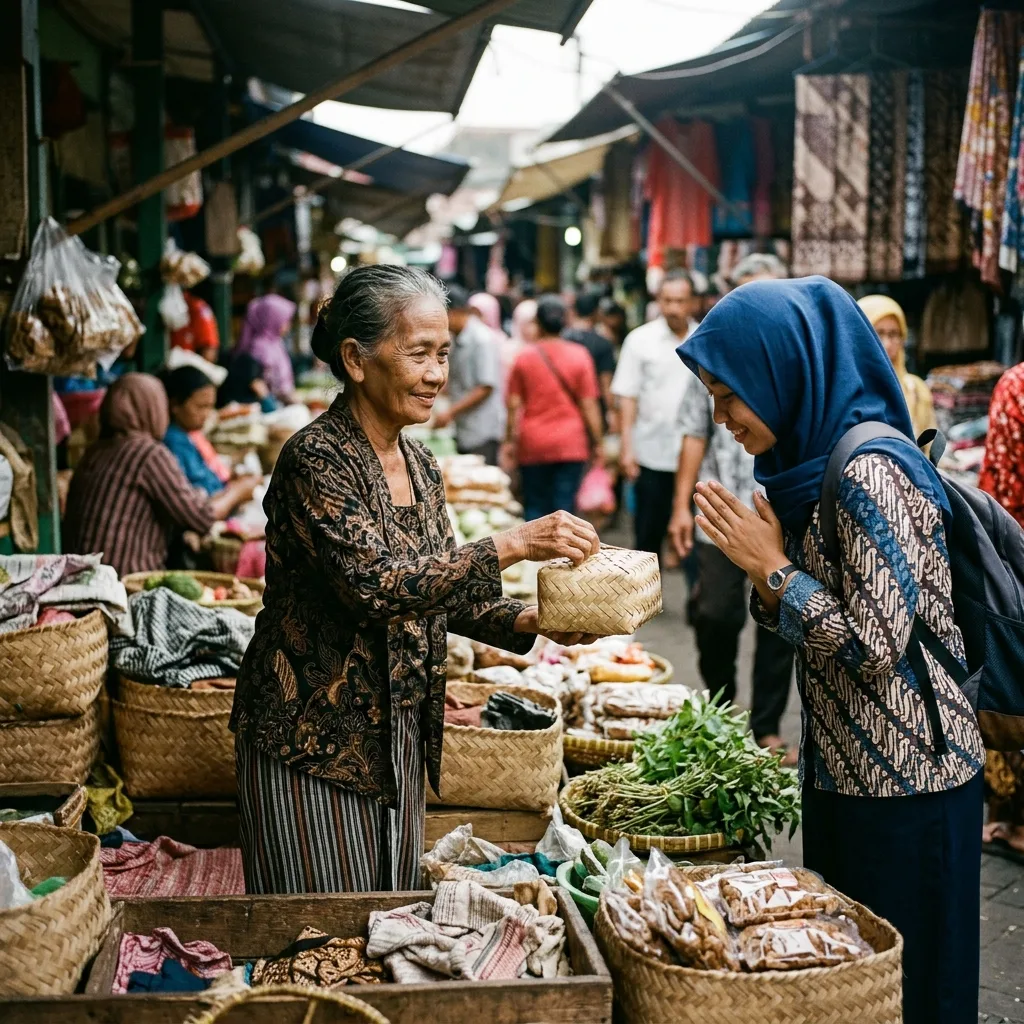
This preference for social refinement overlaps with another rule frequently presented to travelers as universal: using the right hand to give, receive, and eat. Travel advice often presents the use of the left hand as a near-universal taboo in Indonesia. In practice, due to Islamic hygiene norms and local customs, using the right hand is considered far more polite in many Indonesian communities. However, it is not an absolute cultural law. While it is respectful to hand money to a street vendor with the right hand, accidentally using the left will rarely cause the vendor to feel profoundly insulted; context and intention carry far more weight than mechanical rule-following.
Similarly, the widely cited warning to "never point with your index finger" is not a national decree, but a distinctly Javanese marker of politeness. As noted by anthropologist Ward Keeler in his study of Javanese social interactions, pointing with the thumb—while the other fingers are curled loosely beneath it—is considered a more refined alternative to extending a rigid index finger. Applying this as a strict rule outside the cultural settings where it developed risks turning a regional marker of refinement into a supposedly national prohibition.
Why Heads and Feet Became a National "Taboo"
The most extreme generalization found in travel media involves the geography of the body. Books often state that the head is a sacred point and the feet are profane. Sociologist Niels Mulder and anthropologist Shelly Errington have extensively documented how traditional Javanese and Southeast Asian belief systems often align status with vertical orientation. Yet, treating this as a rigid rule across the entire country—implying that a tourist playfully patting a child's head in an airport will trigger a spiritual crisis—turns regional philosophy into an exoticized caricature.
Bali: Where Etiquette Becomes Ritual Purity
While Java focuses on social refinement, Bali's unwritten rules operate on an entirely different axis: ritual purity. Here, boundaries shift from social etiquette to spatial and cosmological laws. Visitors to many Balinese temples are expected to wear a waist sash (selendang), often together with a sarong depending on the temple and local practice. This is a functional practice that physically separates the earthly desires of the lower torso from the spiritual nature of the upper body, establishing a micro-cosmos of purity before approaching the shrine.
This cosmological framework also dictates the strict, and often misunderstood, rule regarding menstruation. Many Balinese temples traditionally restrict entry to anyone with an open bleeding wound or women who are actively menstruating. Rather than framing this as misogyny, anthropologist Brigitta Hauser-Schäublin places such restrictions within a Balinese cosmological framework of ritual purity and equilibrium. Human blood is believed to attract Bhuta Kala, negative spiritual energies that actively disturb the temple's delicate balance. It is a specific religious protocol, not a generalized Indonesian social taboo.
The One Rule That Travels Better Than the Others
One lesson does travel more easily across regional boundaries: public anger is often a poor strategy. Raising your voice in anger, showing frustrated impatience, or publicly demanding an explanation is rarely effective. In Javanese settings, this can be understood through ideas such as malu (shame), alus, and the avoidance of kasar behavior. Rather than resolving a dispute, losing your temper signals an infantile lack of self-control. The typical response is not confrontation, but a quiet, embarrassed withdrawal where assistance is silently refused.
Ultimately, there are no universal hidden traps waiting to ruin a traveler's trip. Indonesian etiquette is not a rigid list of things to avoid; it is a fluid negotiation of context, religion, and geography. Understanding the actual origins of these customs—whether it is Javanese refinement or Balinese purity—transforms them from intimidating tourist rules into fascinating windows into how different societies define order.
Frequently Asked Questions
Is it really offensive to use the left hand in Indonesia?
Using the right hand is highly preferred for eating and giving items due to Islamic and regional norms. However, foreigners accidentally using their left hand are rarely met with deep offense; context and politeness matter more than absolute rules.
Can tourists enter Balinese temples during their period?
Many Balinese temples traditionally restrict entry during menstruation or active bleeding. This is based on a localized cosmological belief that human blood attracts negative spiritual energies, rather than a generalized Indonesian taboo.
How should you point at something in Indonesia?
In many Javanese settings, pointing with the right thumb is considered more refined than extending the index finger. However, this is a regional marker of politeness, not a strict national law.