Sago Grubs: The Forest Protein of Papua
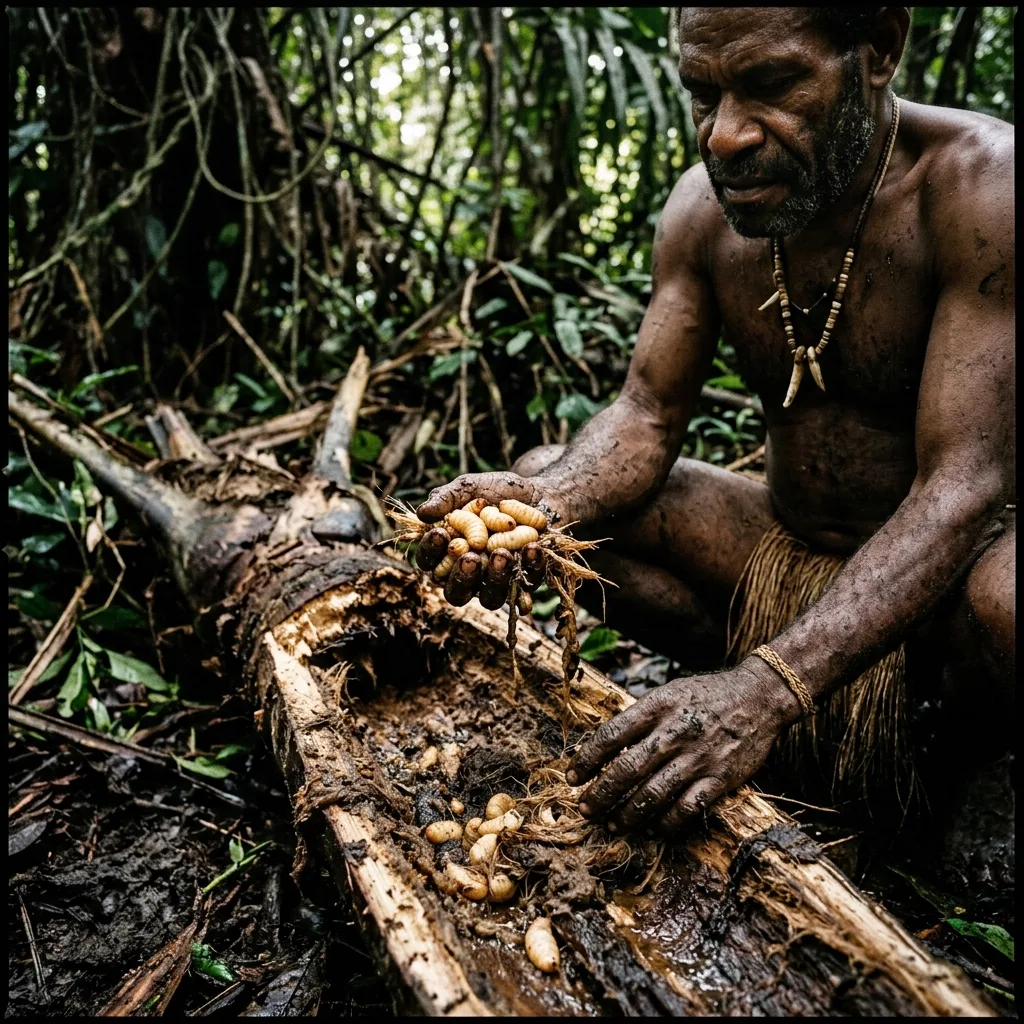
In the rainforests of Papua, indigenous communities deliberately harvest sago grubs by felling palm trees, turning the decaying wood into a productive habitat.
In the rainforests of Papua, the sago palm is not merely a source of starch; it is the foundation of a forest food production system. For several sago-dependent communities in Papua, harvesting sago grubs forms part of a broader relationship with the sago forest. The larvae of the sago palm weevil (Rhynchophorus bilineatus) function as a concentrated source of fat and protein, deeply integrated into the local ecology.
The harvest is a deliberate process. When a mature sago palm nears the end of its life cycle or is harvested for starch, the trunk is often felled and left in the humid environment. As the exposed pith begins to decay, adult weevils are attracted to the trunk and lay their eggs in the softened tissue. Returning several weeks later, harvesters split the decaying logs with axes or machetes to collect the developed larvae. In this way, the fallen tree functions as a managed incubator, converting carbohydrate-rich palm tissue into concentrated insect protein.
The Sago Economy
Anthropological records, such as Koentjaraningrat's 1993 study Masyarakat Irian Jaya, emphasize the central role of the sago ecosystem in Papuan societies. The grubs hold significant value in the local forest economy. At various trading hubs, they are often exchanged alongside other staple goods like smoked fish and tubers, contributing to local exchange and trade within isolated regions.
The nutritional yield of this practice is substantial. Their high fat content makes the larvae a concentrated source of dietary energy within a broader sago-based food system.
Culinary Practice
Consumption in the forest is straightforward. The grubs are frequently eaten raw immediately after extraction. The insect is held by its hard head, bitten off at the neck, and the body is consumed. Raw grubs have a high fat content that gives them a dense, creamy texture.
Alternatively, they are roasted over an open wood fire. Skewered on thin sticks, the heat liquefies the interior fat while the exterior skin crisps. This preparation method alters the texture and imparts a strong smoky flavor from the fire.
Dietary Transitions
Historically, sago starch and sago grubs formed part of a broader sago-based food system that sustained Papuan populations. Today, this system faces significant pressure from national food security policies. Programs intended to subsidize imported white rice in remote districts have altered local food availability and dietary preferences.
This shift has placed pressure on the traditional sago ecology, sometimes marginalizing the complex forest management practices that supported it. However, the deliberate harvesting of sago grubs persists. For these indigenous communities, the practice is not an extreme dietary anomaly; it is a pragmatic, highly adapted method of securing sustenance from the natural cycles of the rainforest.
Frequently Asked Questions
Are sago grubs safe to eat raw?
Sago grubs are traditionally eaten raw in some Papuan communities, but traditional consumption does not eliminate food-safety risks associated with eating raw animal products. Cooking them thoroughly reduces those risks.
Why are sago grubs important in Papua?
They function as a highly reliable, deliberately harvested source of fat and protein, and have historically served as a valuable food commodity within the local forest economy.
What does a roasted sago grub taste like?
When roasted, the high fat content creates a dense, rich interior while the exterior becomes crispy, often carrying the smoky flavor of the wood fire.