The Frozen Ghost of Sólheimasandur: A Monument to Icelandic Weather
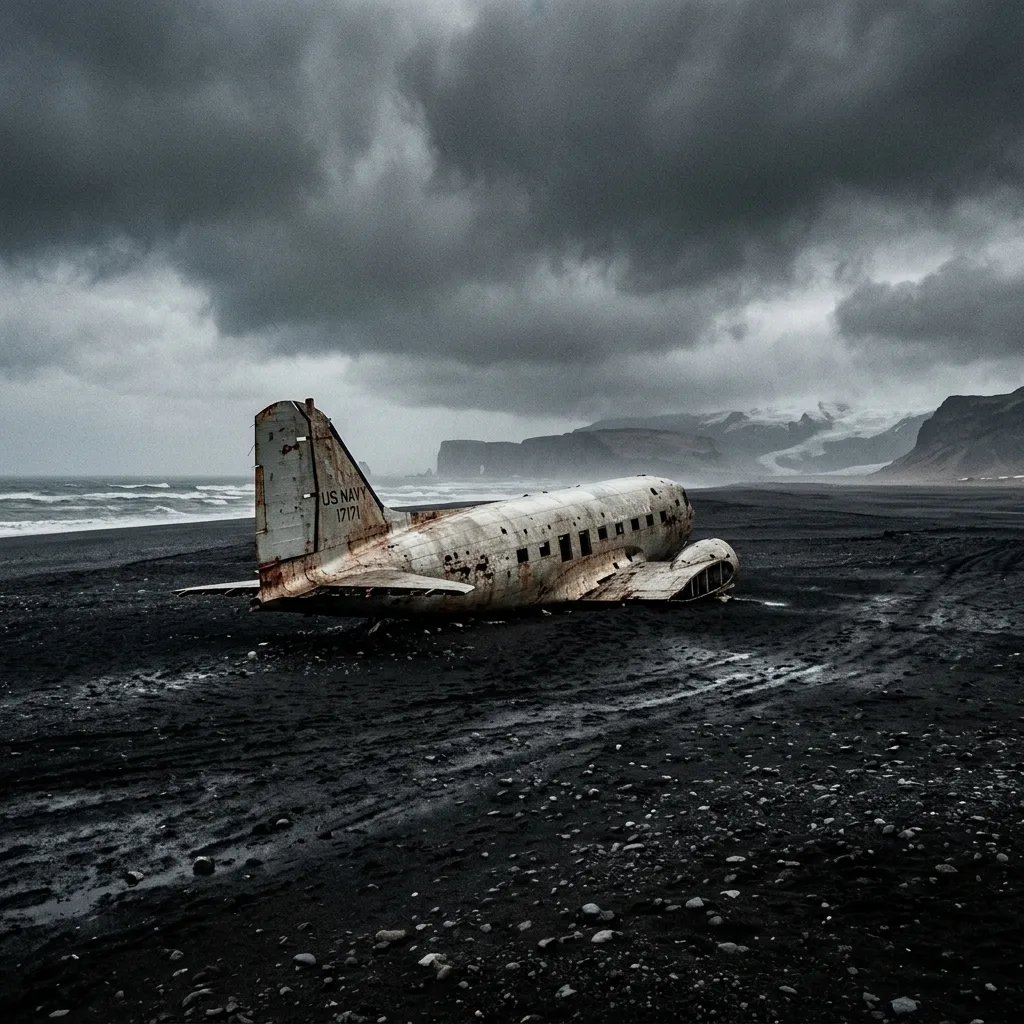
Far out on a desolate black sand plain lies the hollowed shell of a U.S. Navy transport plane. But the true danger of Sólheimasandur isn't the crash itself—it's the brutal, deceptive walk to reach it.
The wind across the southern coast of Iceland does not merely blow; it strips the heat from the lungs. On the black basalt sands of Sólheimasandur, this wind carries the abrasive bite of glacial ice and Atlantic salt. Here, completely exposed to the elements, lies the decaying, wingless fuselage of a United States Navy Douglas C-117D transport aircraft. It has rested on this desolate plain since the harsh winter of 1973, slowly surrendering its aluminum skin to the grinding force of the Icelandic weather. What began as a military emergency landing has mutated over five decades into a bizarre pilgrimage site for the digital age, a stark juxtaposition of Cold War aviation history and modern Instagram tourism.
For decades, travel blogs and internet forums endlessly repeated a fabricated lore surrounding the crash, often attributing it to pilot error—a myth claiming the crew mistakenly switched to the wrong fuel tank. Further compounding the inaccuracies, the crash date was widely, and incorrectly, cited as November 24, 1973. However, primary historical records dismantle these digital rumors. According to the archives of the Icelandic newspaper Morgunblaðið, which reported the incident contemporaneously on November 22, 1973, the emergency landing actually occurred on November 21. The flight, en route from Höfn to Naval Air Station Keflavik, was forced down not by human error, but by severe atmospheric icing that compromised the aircraft's engines and lift capabilities. Miraculously, all seven crew members survived the brutal touchdown on the frozen sand.
Following the rescue, the U.S. Navy stripped the aircraft of its engines, avionics, and usable military hardware, abandoning the empty hull to the elements. For decades, the wreck was known only to local sheep farmers and a handful of intrepid hikers. It was an obscure, rusted secret hidden in plain sight. But the internet rarely leaves secrets buried. The site exploded into global consciousness following its feature in Justin Bieber's 2015 music video for 'I'll Show You', and subsequently in the Bollywood blockbuster 'Dilwale'. Almost overnight, Sólheimasandur transitioned from an obscure historical anomaly into a mandatory checklist item for millions of tourists.
The Extraction of the Black Sand
The sudden influx of thousands of daily visitors triggered an immediate ecological crisis. Rental cars and off-road vehicles blindly followed GPS coordinates off Route 1, tearing deep, irreparable ruts into the fragile black sand and destroying the sparse, slow-growing vegetation. The sheer volume of traffic fundamentally altered the landscape, prompting local landowners to take drastic action. In early 2016, a gate was erected, effectively banning all vehicular access to the wreck. The decision was not an act of malice, but an act of ecological triage. Today, reaching the fuselage requires a physical toll: a punishing, monotonous four-kilometer walk across the barren plain in each direction.
This mandatory march exposes the stark contrast between the curated aesthetic of travel photography and the harsh reality of the Icelandic environment. The walk is deceptively flat, yet entirely unshielded from the ferocious coastal gales. In the height of summer, it is an exhausting trudge; in winter, it is a perilous gamble. The visual emptiness of the black sand disorients the senses, making distances impossible to judge. Tourists, often ill-equipped and driven solely by the desire for a photograph, routinely underestimate the lethal potential of the sudden whiteouts and plummeting temperatures that sweep across the plain.
The High Cost of a Photograph
The consequences of underestimating Sólheimasandur have been fatal. While the original military crew survived the 1973 crash, the modern pursuit of the wreck has claimed lives. In January 2020, rescue teams found the bodies of two young tourists who had succumbed to exposure and hypothermia while attempting the trek in severe winter conditions. The tragedy underscores a grim paradox: the aircraft that once represented survival has become a literal death trap for the unprepared. The physical danger of the walk starkly frames the absurdity of modern tourism, where the compulsion to capture a specific, widely replicated image outweighs basic self-preservation.
To capitalize on this manufactured demand—and to mitigate the continuous need for search and rescue operations—a commercial solution emerged. A shuttle bus now operates from the parking lot, ferrying tourists across the four kilometers of sand for a steep fee. This industrialization of the site completes its transformation. It is no longer a silent monument to the Cold War or a testament to human survival. It has transformed into a highly commercialized tourist stop, far removed from its origins.
When standing before the pitted, graffiti-scarred metal of the C-117D, the true nature of Sólheimasandur reveals itself. The most powerful force at work here is not the legacy of the U.S. military, nor the fleeting fame of pop culture. It is the wind, carrying the black sand, steadily and mercilessly erasing both the aircraft and the footprints of the thousands who march toward it.
Frequently Asked Questions
Why is the Sólheimasandur plane crash famous?
It became globally famous primarily due to its striking, apocalyptic visual appeal, which was popularized by social media influencers and music videos, notably Justin Bieber's 2015 video 'I'll Show You'.
Is it true the pilot switched to the wrong fuel tank?
No, that is a pervasive myth. Primary reports from November 1973 confirm the crash was caused by severe icing conditions that disabled the engines, not pilot error regarding fuel switches.
How long is the walk to the DC-3 wreck?
The walk is precisely 4 kilometers (2.5 miles) each way from the designated parking area on Route 1, totaling an 8-kilometer (5-mile) round trip over flat but exposed terrain.
Is the Sólheimasandur plane wreck really a DC-3?
The wreck is popularly called the 'DC-3 wreck', but the actual aircraft that crash-landed is a Douglas C-117D, a variant developed from the DC-3 family.