Djúpavík Ghost Factory: The Ruins of Iceland's Herring Rush
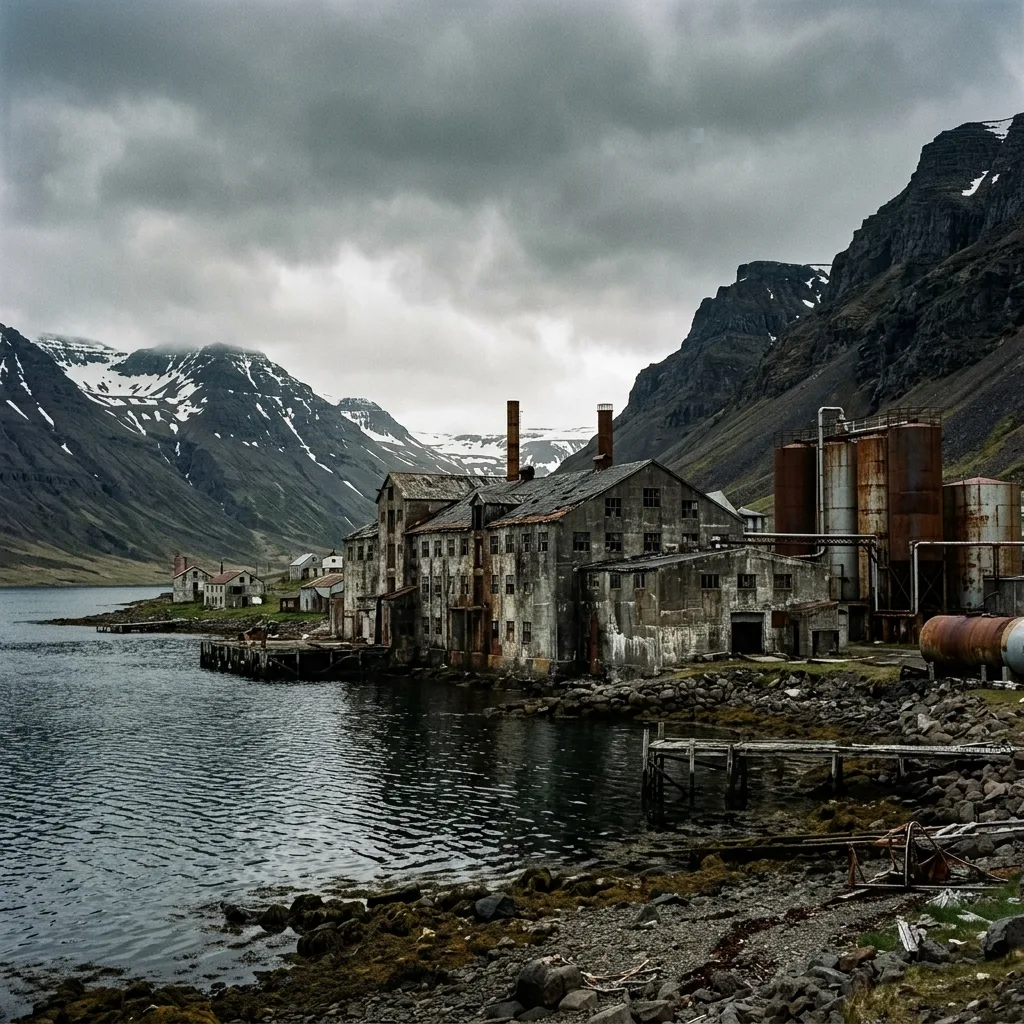
A 90-meter concrete monolith in the remote Westfjords stands as a rusting monument to an ecological collapse and the grueling labor of the Síldarstúlkur.
In the winter of 1934, hundreds of laborers arrived at the remote Reykjarfjörður fjord on the Strandir coast. They came to construct something that seemed nearly absurd for such a harsh location: a 90-meter herring processing factory. Upon its completion in 1935, it stood as the largest concrete building in Iceland. For a brief decade, this isolated outpost functioned as the center of an Icelandic gold rush, processing thousands of tons of herring. Today, the factory sits abandoned, a colossal carcass of rusted steel and concrete degrading in the Arctic wind.
Behind the factory's massive output was immense physical labor, much of which fell to the Síldarstúlkur, the "Herring Girls." Historian Jón Þ. Þór, in his 1992 book The Herring Era in Iceland, documents how these young women worked relentless shifts in freezing, outdoor conditions, gutting and salting fish with bleeding, salt-cracked hands. They were housed in cramped, uninsulated wooden barracks known as Kvennabragginn, operating entirely at the mercy of unpredictable catches and the harsh subarctic climate.
When the Fish Vanished
The factory was built with reinforced concrete to withstand the violent storms of the Westfjords. It featured massive steam boilers and reduction machinery imported from Europe. This infrastructure represented a forceful attempt to impose industrial permanence on a deeply volatile environment.
Ironically, the factory's massive capacity relied on something it could not control: the presence of herring schools. By 1944, the herring stocks in the bay began to vanish, driven by a combination of aggressive fishing and shifting oceanographic conditions. In 1954, the operation was formally abandoned. As the jobs disappeared, residents gradually left Djúpavík, leaving the machinery locked in place and the massive concrete walls to crack under the extreme thermal contraction of the Icelandic winter.
Inside the Factory
Entering the factory today requires navigating a landscape of industrial decay. The main processing halls are littered with rusted gears the size of a human, flaking away into fine dust. Water drips continuously from the collapsed roof. In 2006, the post-rock band Sigur Rós utilized the immense natural acoustics of the empty fish oil tanks for a performance, momentarily filling the void with sound.
Reaching Djúpavík requires traversing Route 643, a rugged, unpaved gravel road that winds along the edge of the Strandir coast. The journey from Hólmavík takes approximately two hours and is strictly a summer endeavor. Visitors are highly advised to wear sturdy, waterproof boots, as the factory floor is riddled with hidden structural hazards and standing water. Guided tours, operating from the adjacent Hotel Djúpavík, are required to explore the interior safely due to structural concerns.
The overpowering smell of ancient fish oil remains deeply embedded in the concrete. Inside the former foreman's office, ledgers from the 1940s still sit on the rotting desks, covered in decades of dust.
Frequently Asked Questions
Where is the Djúpavík herring factory located?
It is located in Reykjarfjörður, a deeply isolated fjord in the Strandir region of the Icelandic Westfjords, accessible via Route 643.
Is it safe to explore the abandoned factory?
The structural integrity of the factory is severely compromised. Exploration should be done strictly through authorized guided tours organized by the nearby Hotel Djúpavík to avoid dangerous collapses.
Why did the factory close?
The factory ceased operations in 1954 after the local herring population plummeted due to a combination of environmental shifts and fishing pressure.