The Real History of Kintsugi: Toxic Sap and Metal Staples
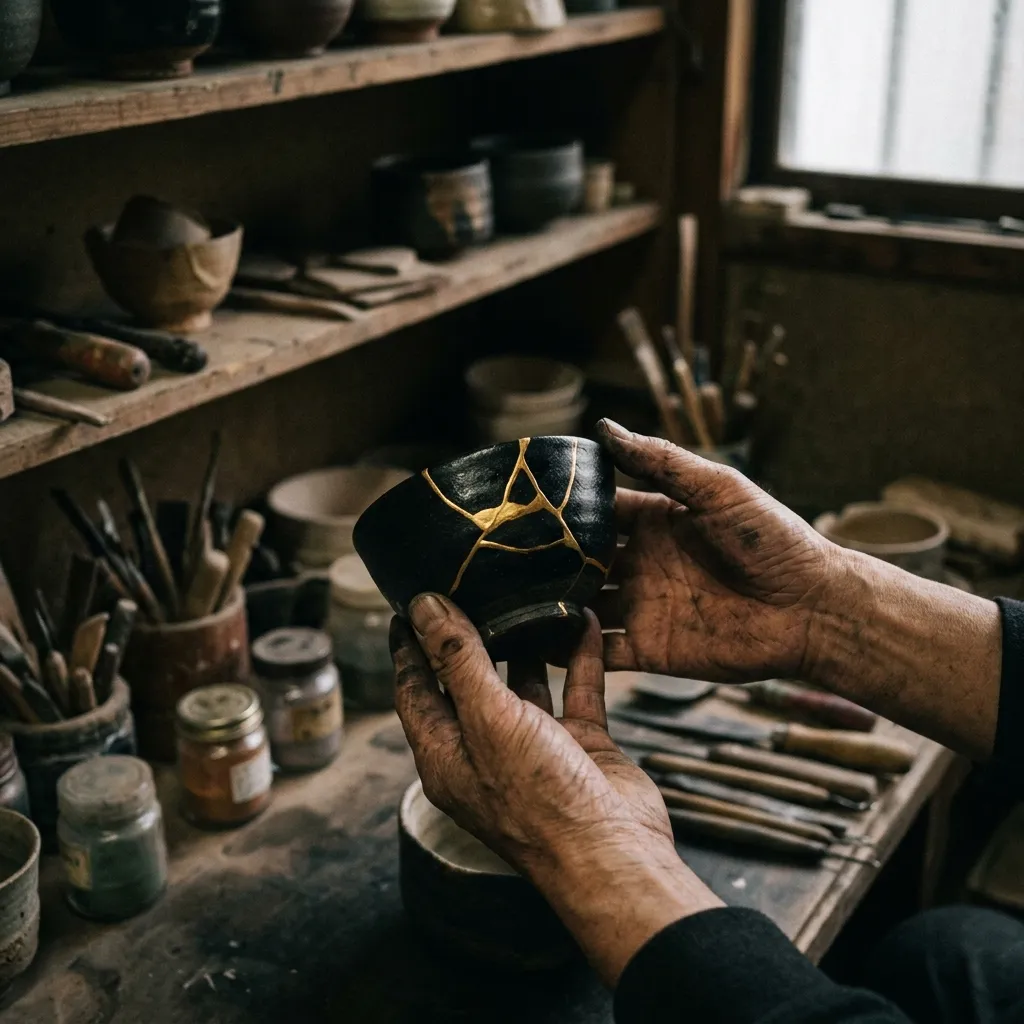
Explore the history of kintsugi beyond the modern self-help metaphor, from the Yoshimasa legend and the real Bakōhan staple repair to allergenic urushi lacquer and gold restoration.
The internet frequently reduces kintsugi to a cheerful self-help metaphor about embracing our flaws, often repeating a famous origin story: In the fifteenth century, the shogun Ashikaga Yoshimasa broke his favorite celadon tea bowl and sent it to China for a replacement. When it returned repaired with ugly metal staples, Yoshimasa was allegedly so disgusted that he ordered Japanese craftsmen to invent a more aesthetic method, leading to the birth of kintsugi.
Kintsugi is the Japanese practice of repairing broken ceramics with urushi lacquer and highlighting the mend with metallic powder, most famously gold.
The Legend of Yoshimasa and the Stapled Bowl
While this story makes for an excellent parable, cultural institutions like Japan House London classify the tale as a much later anecdote rather than a verified historical event. The exact origin of kintsugi is unknown. Historians generally place its development in the Muromachi period (1336–1573), and by the sixteenth century the technique appears to have been in established use.
The most famous physical evidence related to this tradition is the Bakōhan (Large Locust) tea bowl, a 13th-century Southern Song dynasty celadon piece currently held as an Important Cultural Property at the Tokyo National Museum. According to the 1727 Bakōhan Saōki, the bowl was sent to China in search of a replacement and returned with its crack fastened by a metal clamp (a technique known as juci). The later record says the clamp increased the bowl's esteem because its shape resembled a large locust resting on the bowl—giving the piece its name.
The Reality of Urushi
The available evidence points not to a sudden invention by a disgruntled shogun, but to a gradual development of lacquer-based ceramic repair during the Muromachi period, rooted in established Japanese lacquerworking techniques. The core binder is urushi, a natural lacquer harvested from the sap of the Toxicodendron vernicifluum tree. In its raw state, the sap contains urushiol, the allergenic substance also responsible for poison-ivy reactions. Artisans working with raw lacquer must navigate severe contact dermatitis, enduring blistering rashes.
Kintsugi also belongs to a much wider lacquerworking tradition. Historically, repairs were carried out by urushi and maki-e specialists, craftspeople already skilled at applying metallic powders to lacquer surfaces.
The repair process relies on humidity rather than evaporation. The urushi does not dry; it cures. The coated ceramic fragments are placed into a muro, a closed wooden cabinet maintained at high humidity and warm temperatures. In this specific environment, the sap polymerizes into a hard, durable lacquer film. Depending on the stage, an object may remain in a humidity-controlled cabinet for days or weeks before the next layer can be applied.
Kintsugi, Tea Culture, and Wabi-Sabi
One important context for the growth of kintsugi was the value placed on cherished tea wares, including imported Chinese ceramics that could be difficult or impossible to replace. As the Japanese tea ceremony (chanoyu) evolved, tea masters began to value a rustic aesthetic of imperfection and simplicity. A repaired bowl ceased to be a ruined object. The golden seams traced the exact topography of the fracture, documenting the object's history without attempting to conceal the damage. This way of valuing age, irregularity and repair was later frequently interpreted through the concept of wabi-sabi.
Beyond the Modern Metaphor
To view kintsugi solely as a philosophical platitude ignores the intense physical labor of the craftsmen and the allergenic hazards of their raw material. Genuine kintsugi (repairing with urushi lacquer dusted in gold powder) is a slow, highly technical discipline. The gold does not magically erase the break. After curing, urushi becomes a strong adhesive that physically reinforces a fragile object so that it can return to everyday use. The resulting golden fault lines are a testament to preservation—a meticulous record of an object surviving its own destruction.
Frequently Asked Questions
Is the urushi sap really toxic?
Yes, in its raw form. Urushi contains urushiol, the same allergenic compound found in poison ivy. Artisans often develop severe allergic reactions and contact dermatitis while working with it. Once properly cured, traditional lacquer is far less likely to provoke the reactions associated with raw urushi.
Did people actually break things just to use Kintsugi?
Stories exist of enthusiastic collectors deliberately breaking ceramics to obtain fashionable repairs, but these anecdotes should not be treated as evidence that this was a common practice. Kintsugi was primarily a practical means to salvage valuable wares.
Can I eat from a Kintsugi bowl?
Properly cured traditional urushi has long been used on food and tableware, but you should verify with the creator. Modern repair kits vary widely. Do not assume an epoxy or metallic powder is food-safe unless the manufacturer explicitly specifies suitability for food-contact use after full curing.