Tajen in Bali: Cockfighting, Gambling and Tabuh Rah Explained
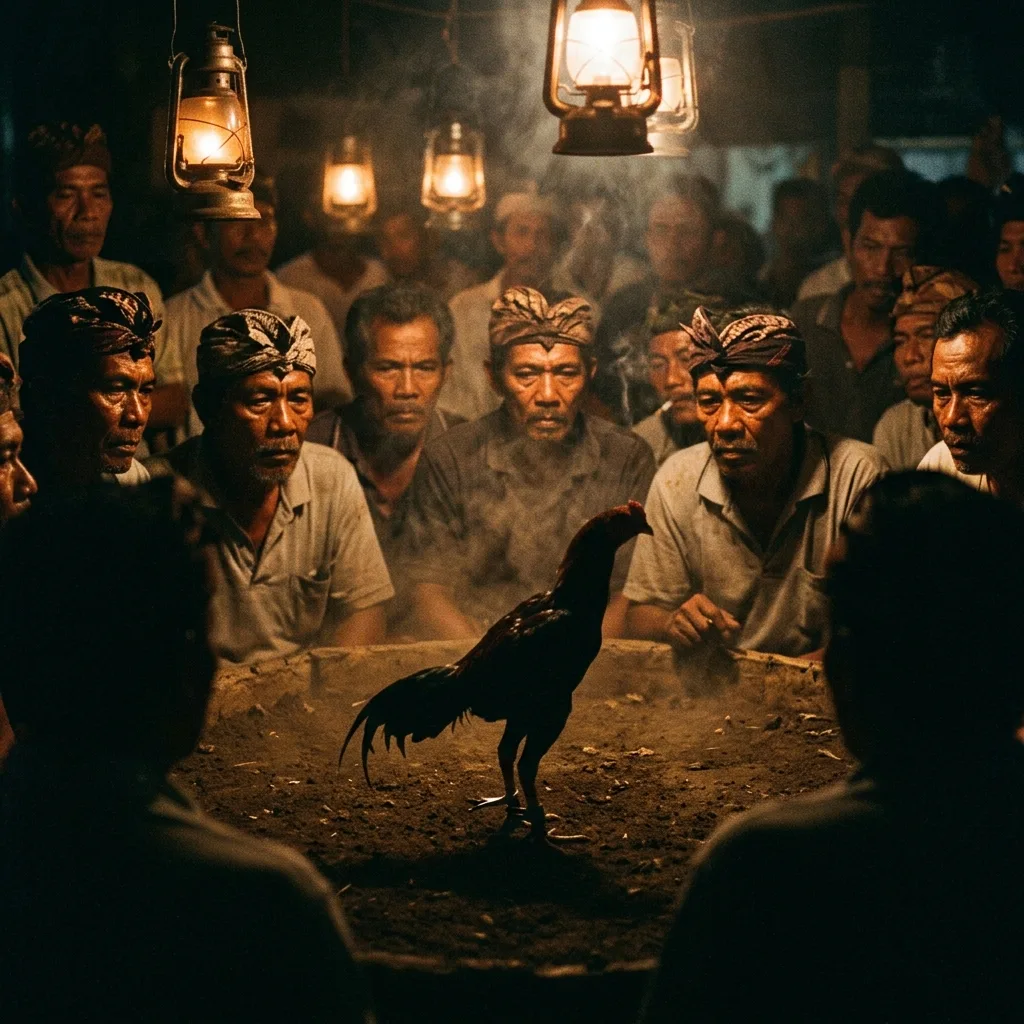
Sensational accounts of Bali often conflate religious blood offerings with illegal gambling rings. The reality of the modern cockfight is far more complex.
A persistent myth surrounds Balinese culture in modern travel writing: the idea that underground cockfighting is a dark, secretive religious ritual. However, not every Balinese cockfight serves the same purpose. The distinction between the foundational religious protocol and the secular gambling event that often follows it is precisely what sensational accounts of Bali tend to erase.
Tajen and Tabuh Rah Are Not the Same Thing
The confusion stems from the historical connection between two distinct practices: Tabuh Rah and Tajen. Tabuh Rah is a highly regulated religious offering (caru). According to Balinese Hinduism, the earth must periodically be ritually cleansed to maintain cosmic balance (Rwa Bhineda). As detailed in contemporary cultural theology studies, this requires a blood offering to appease lower spirits (bhuta kala). A Tabuh Rah ceremony requires blood to touch the earth, often during temple anniversaries or purification rites. It is a brief, sacred necessity, not a spectacle.
Tajen, on the other hand, is the gambling-driven cockfight. While a Tajen may historically be held in the vicinity of a temple following a Tabuh Rah ceremony, its primary function is entertainment and betting.
The Gray Area Between Ritual and Crime
In reality, cultural phenomena rarely divide neatly into "sacred" and "secular" boxes. Modern sociological studies on Balinese gambling note that the line is frequently blurred deliberately. Because Tabuh Rah is a protected cultural tradition, underground gambling networks sometimes use the ritual as a cultural shield—scaling up a brief religious necessity into a massive betting operation to circumvent police crackdowns. This creates a complex negotiation between local cultural preservation (Ajeg Bali) and state law enforcement, where tradition and modern deviance overlap.
What Clifford Geertz Actually Saw
The global fascination with the Balinese cockfight was largely cemented by American anthropologist Clifford Geertz in his 1972 essay, Deep Play: Notes on the Balinese Cockfight. Geertz argued that the cockfight was not merely animal combat, but a profound simulation of the Balinese social matrix, where men navigated status, masculinity, and village allegiances through proxy combatants.
However, it is crucial to recognize the temporal context of Geertz's work. His fieldwork took place in an ordinary Balinese village in 1958. Geertz's observations provide a vital historical and ethnographic baseline for understanding the social structure of mid-century Bali, but they are not a literal description of the modern, highly policed underground gambling rings that exist today.
From Village Allegiance to Illegal Gambling
The betting system that Geertz observed laid the groundwork for modern Tajen, which still operates without written ledgers, relying instead on hand signals and a strict honor code. But the landscape of gambling in Indonesia has shifted dramatically. Contemporary criminological research highlights that modern Tajen is often driven more by economic gain and underground syndicates than by the village allegiances of the 1950s. The Indonesian government views this large-scale betting not as a cultural preservation effort, but as a criminal enterprise.
Is Tajen Legal in Bali Today?
The legal status of cockfighting in modern Indonesia is frequently misunderstood. There is no legal exemption for gambling in Bali. While the religious ritual of Tabuh Rah is recognized and protected under customary law, neither local regulations (Perda) nor Customary Village Councils (Majelis Desa Adat) can override national law.
Historically regulated under the Dutch colonial-era Criminal Code and Law No. 7 of 1974, the strict prohibition on gambling was recently reaffirmed with the enactment of Indonesia's new National Criminal Code (Undang-Undang No. 1 Tahun 2023), which took effect in early 2026. The moment money is wagered on a cockfight, it ceases to be a protected cultural practice and becomes a criminal offense, prompting regular police raids even during temple festival seasons.
Why Calling It a “Dark Ritual” Misses the Point
Framing the modern underground Tajen as a "dark ritual" misrepresents both the religion and the reality of the gambling ring. Tabuh Rah is a pragmatic, transparent spiritual protocol for managing ecological and cosmic balance. Tajen is a complex socio-economic event shaped by status, money, and modern national law.
When observers conflate the two, they inadvertently exoticize a pragmatic society, reducing a nuanced legal and cultural balancing act into a simplistic horror trope. The reality of how a modern Balinese community navigates the tension between sacred duty, social status, and state law is far more interesting than the sensationalized myths.
Frequently Asked Questions
Is Tajen the exact same thing as Tabuh Rah?
No. Tabuh Rah is a religious blood offering required for purification rituals to appease lower spirits. Tajen is the secular, gambling-driven cockfight that historically followed the ritual but serves a distinct socio-economic purpose.
Is cockfighting legal when performed as part of a Balinese religious ceremony?
There is no legal exemption for gambling. The purely religious act of shedding blood for Tabuh Rah is recognized by customary law, but the moment money is wagered (Tajen), it becomes a criminal offense under Indonesia's National Criminal Code, regardless of whether a customary village council permits it.
Why do police raid cockfights in Bali if it is a tradition?
Because modern Tajen is frequently operated by underground syndicates using the religious tradition of Tabuh Rah as a cultural shield. The police raid these events to crack down on the massive illegal betting rings, not to stop the religious ceremony.