Who Are Jakarta's Silver Men?
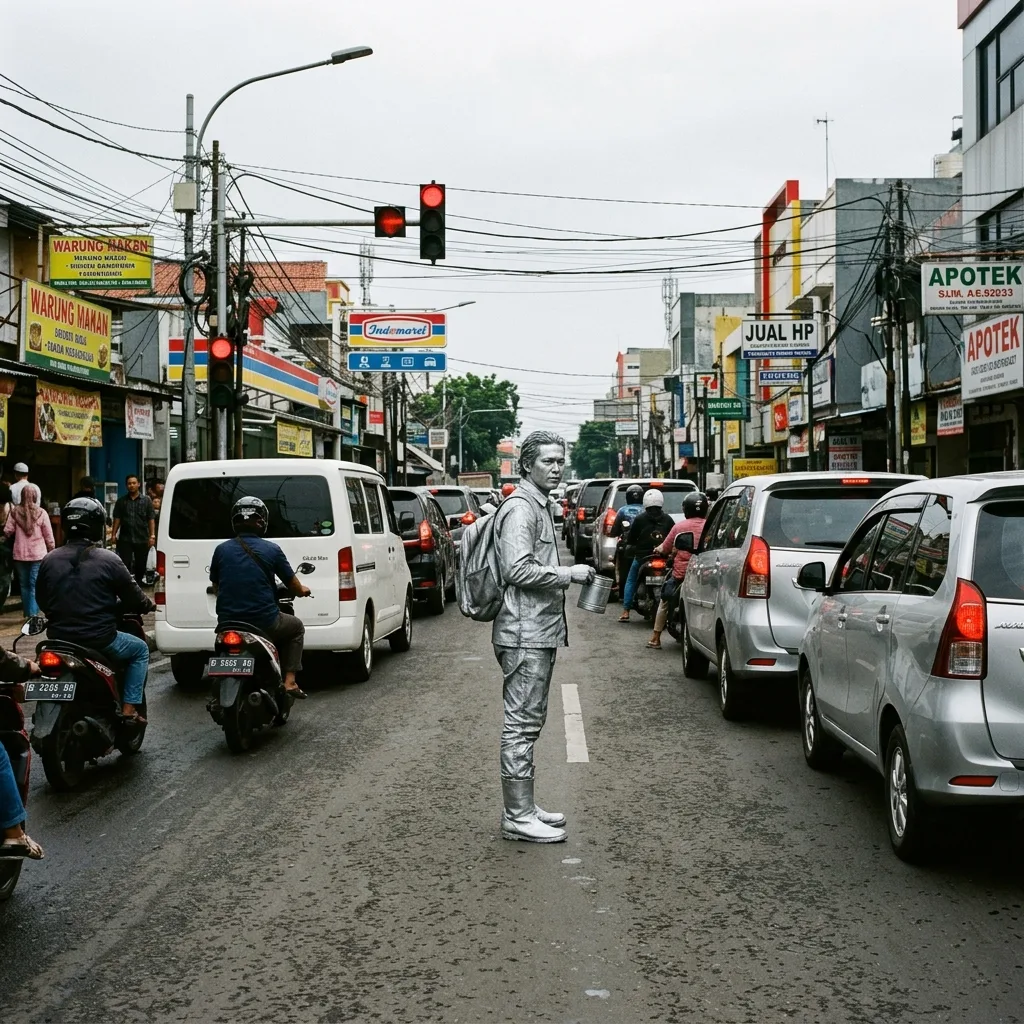
With their silver-coated bodies and living-statue poses, the Manusia Perak are easily seen as just another street performance. In reality, the phenomenon sits at the intersection of the informal economy, the risks of non-cosmetic materials, and municipal public order policies.
At major intersections in Jakarta, among the dense flow of motorcycles and cars, it is common to see individuals standing completely motionless between the lanes. They are painted entirely in a metallic silver color from head to toe, holding small cardboard boxes or plastic buckets. Locally known as 'Manusia Perak' (Silver Men), they perform as living statues, capitalizing on the heavy traffic gridlock that defines Southeast Asia's largest megacity.
While their striking visual appearance might suggest a deeply rooted cultural tradition, the phenomenon is relatively recent. This practice serves as an adaptation within the city's informal economy, illustrating how marginalized populations innovate to secure daily income.
Why Are They Painted Silver?
The origins of the Manusia Perak can be traced back to neighboring Bandung around 2012. Initially, groups such as 'Silver Peduli' adopted the silver paint and living-statue concept to attract attention and raise charitable funds for local orphanages. The silver color gave them a highly visible presence in public spaces.
Over the subsequent years, the tactic evolved from a coordinated charity drive into an individual street profession. The model was increasingly adopted as a method to earn money on the streets, as the striking visual presentation proved effective at distinguishing them from the surrounding urban noise.
What Is Actually in the Paint?
The metallic sheen is not achieved through cosmetic body paint, which would be financially unviable for daily use. Instead, the coating is typically a homemade mixture. According to investigative reports by local media outlets such as Kompas, performers commonly use industrial screen-printing powder (bubuk sablon) mixed with oil to help it adhere to the skin.
The use of mixtures not designed as cosmetics can cause skin irritation. Several Manusia Perak interviewed by the media reported itching, redness, or discomfort after hours of wearing and subsequently scrubbing off the layer.
How Much Can a Silver Man Earn?
The decision to engage in this activity is primarily economic. In a Kompas report, the cost of materials was cited at around Rp 35,000, while the daily income of the subjects interviewed was in the range of Rp 50,000 to Rp 100,000. Actual earnings vary depending on location, working hours, and traffic volume.
What Jakarta's Law Actually Says
Operating as a Manusia Perak at Jakarta's intersections intersects with municipal regulations. The legal framework governing this is the Regional Regulation of the Special Capital Region of Jakarta (Perda DKI) No. 8 of 2007 concerning Public Order.
The regulation explicitly prohibits individuals from begging or performing (mengamen) at intersections, traffic lights, and inside public transportation. Crucially, the law also targets the donors: it is a violation for motorists or pedestrians to give money to beggars or street performers in these specified public spaces.
What Happens When Satpol PP Picks Them Up?
Enforcement of this regulation is carried out by the municipal police, known as Satpol PP. Silver Men are sometimes targeted during public order sweeps. In the standard operating procedures (SOP) referenced by the Social Services Agency (Dinas Sosial), they are placed in the category of PMKS (Penyandang Masalah Kesejahteraan Sosial).
When apprehended, they are not typically sent to a conventional prison. Instead, the standard operating procedure dictates that they are transported to state-run social institutions, such as Panti Sosial Bina Insan Bangun Daya. In these facilities, they undergo administrative data collection and social guidance according to applicable procedures.
Frequently Asked Questions
Are the Silver Men in Jakarta part of an organized syndicate?
There is no basis in the sources used for this article to describe Manusia Perak generally as an organized criminal syndicate. The phenomenon is more accurately understood as a form of informal street labor.
Is it legal to give money to the Silver Men at intersections?
No. Under Jakarta's Perda No. 8 of 2007 on Public Order, both the act of street begging at intersections and the act of giving money to them are prohibited.
Are there health risks to using the silver paint?
Because they use industrial screen-printing powder mixed with oil instead of cosmetic body paint, the use of mixtures not designed as cosmetics can cause skin irritation, itching, and discomfort.