Rakotzbrücke: The Perfect Circle of the Devil's Bridge
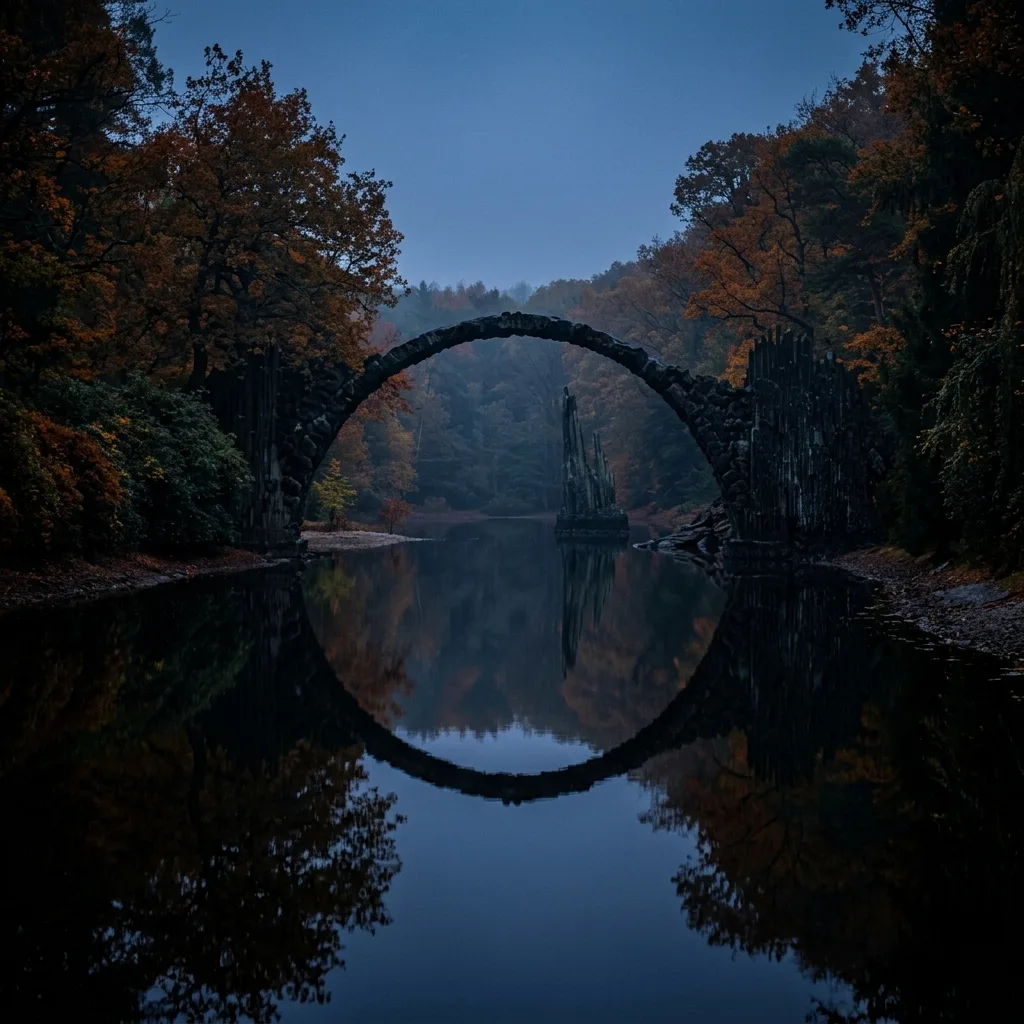
Deep in the woods of Saxony stands a 19th-century basalt bridge designed to create the illusion of a near-perfect circle when reflected in still water.
Hidden within the forested acreage of Kromlauer Park in eastern Germany, just miles from the Polish border, lies a 19th-century structure renowned for its precise optical illusion. The Rakotzbrücke, often called the Devil's Bridge, is a thin arch constructed from dark basalt stone that stretches across the surface of Lake Rakotz. When the water is perfectly still, the arch and its reflection merge seamlessly to form a near-perfect circle.
Commissioned in 1860 by the local landowner Friedrich Hermann Rötschke, the bridge was never intended for practical transportation. The bridge fits the Romantic tradition of 19th-century landscape design, where dramatic artificial ruins, grottoes, and ornamental structures were used to shape the experience of a park.
The Architecture of the Basalt Arch
The construction of the Rakotzbrücke was a highly complex feat of 19th-century masonry. The dark, jagged columns of basalt used for the arch do not naturally occur in the sandy soils of Kromlau. Rötschke sourced the heavy stones from distant quarries in the Saxon Switzerland region, hauling them by ox-cart over rough terrain. Balancing these massive, irregular weights to create a delicate arch without modern steel reinforcement required meticulous engineering.
The visual effect of the perfect stone ring feels stark against the wild growth of the surrounding woods. To preserve the structure's precarious balance, the bridge was built with an extremely narrow walkway and no guardrails. Its unusual appearance eventually led to its popular nickname, linking it to a much older European tradition of similarly named bridges.
The Devil's Pact and Local Superstition
Like many European bridges later associated with the Devil, Rakotzbrücke has attracted versions of the familiar “Devil's Bridge” legend, in which supernatural help comes at the price of the first soul to cross. Whether this story historically originated in Kromlau is less clear.
The 2021 Multi-Million Euro Restoration
After decades of weathering and structural deterioration, the bridge underwent an extensive restoration between 2017 and 2021. The local government initiated a 4.2-million-euro project where structural engineers carefully drained Lake Rakotz entirely. The basalt stones were reinforced with hidden, modern supports. The lake was slowly refilled, and the restored site reopened to visitors in May 2021, although walking across the bridge remained prohibited. Today, the Rakotzbrücke remains perpetually suspended in the forest as a monument to 19th-century landscaping.
Frequently Asked Questions
Can I walk on the Devil's Bridge?
No. Walking across Rakotzbrücke is prohibited to protect the historic structure.
When is the best time to see the perfect circle illusion?
Calm conditions are most important because still water produces the clearest circular reflection. Early morning can offer calmer water and fewer visitors.
Is the lake water natural?
Lake Rakotz is an artificially created lake. During the bridge's massive 2017–2021 restoration, the lake was completely drained to allow structural engineers to reinforce the bridge's foundation.