Teufelsberg: The Devil's Mountain and the Eavesdropping Domes
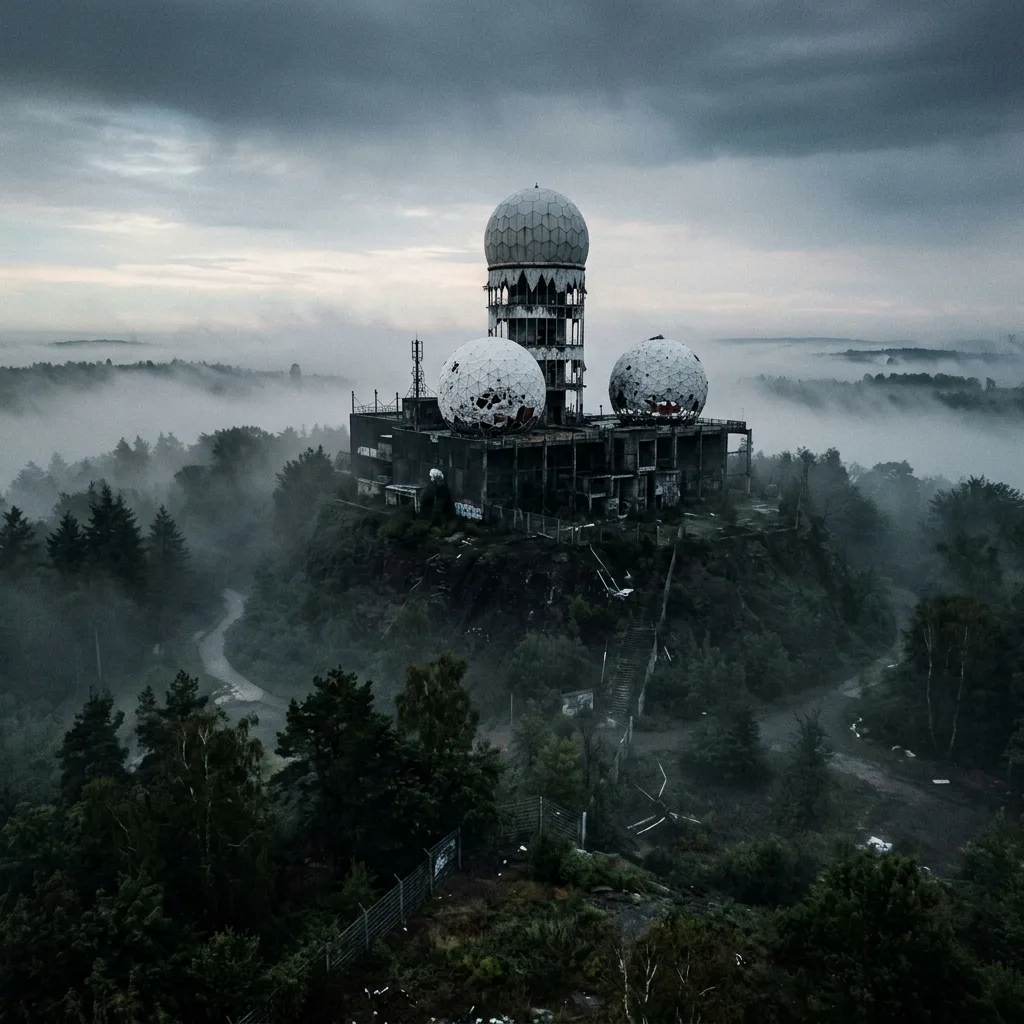
Rising above Berlin's Grunewald forest, Teufelsberg is an artificial hill built from millions of cubic meters of WWII rubble. At its summit stands a former Cold War listening station, now transformed into an open-air street art gallery.
Rising above the Grunewald forest, Teufelsberg (Devil’s Mountain) appears to be a natural hill topped by a cluster of tattered white spherical domes. However, it is an artificial geographical anomaly. As urban historian Brian Ladd noted in his 1997 work The Ghosts of Berlin, Teufelsberg is constructed from the pulverized ruins of World War II Berlin, crowned by the remnants of a Cold War listening station used by US and British intelligence.
Built on Speer's Concrete
Beneath the hill lies the heavy concrete foundation of a Nazi military-technical college, designed by Albert Speer. Following the war, Allied forces attempted to destroy the massive bunker using explosives. When the structure proved too resilient, authorities decided to bury it instead.
For two decades, roughly 800 trucks a day dumped rubble from Berlin’s bombed streets onto the site. Over 26 million cubic meters of debris—representing about one-third of the destroyed city’s buildings—were piled up, entombing the military college under bricks and mortar. Teufelsberg now rises to about 120 meters above sea level, standing roughly 80 meters above the surrounding plateau.
Field Station Berlin
During the Cold War, the elevated position of this artificial mountain presented a unique tactical advantage. In the 1960s, a joint intelligence operation led by the US National Security Agency (NSA) recognized that Teufelsberg offered an unobstructed radio line of sight deep into East Germany and the Soviet Bloc. They constructed Field Station Berlin, a highly classified listening post. The iconic spherical radomes were built to protect sensitive antennas and listening equipment from weather and surveillance.
For nearly thirty years, American and British intelligence officers worked inside the windowless structures, monitoring and intercepting military and other communications from East Germany and the Soviet Bloc. The station was heavily fortified, surrounded by multiple layers of barbed wire and watchtowers, operating in strict isolation above the divided city.
From Espionage to Street Art
Following the fall of the Berlin Wall in 1989, the station became obsolete. The facility was abandoned in 1992 after the removal of classified equipment. Subsequent attempts by private investors to commercialize the site into luxury apartments or hotels failed due to local opposition and environmental regulations.
Today, the site's interior has been stripped of valuable metals, and its concrete walls are continuously covered by local and international graffiti artists, making it one of the largest open-air street art galleries in Europe.
Visiting Teufelsberg Today
Access to Teufelsberg is now managed by an organization that maintains the site and charges an entry fee. Visitors can walk around the massive street art gallery and access the main radar dome. Guided historical tours are also available, providing context on the site's complex Cold War operations.
Acoustics of the Main Radome
The ascent to the top of the main tower involves navigating dark stairwells. At the summit sits the main radome. The curved interior of this spherical dome creates a pronounced acoustic effect, causing whispers, footsteps, and other sounds to reverberate for several seconds.
Frequently Asked Questions
Can you legally visit Teufelsberg?
Yes. Teufelsberg is managed by an organization and officially open to the public for a fee. You can walk around the street art gallery and climb up into the main radar dome. Guided historical tours are also available.
What is the acoustic effect in the spherical radome?
The curved interior creates a pronounced echo, causing whispers, footsteps, and other sounds to reverberate for several seconds.
Is the Nazi military college still under the hill?
Yes. The concrete foundations proved too difficult for the Allies to destroy after WWII, so they remain buried deep beneath the 26 million cubic meters of rubble that forms the artificial mountain.